

· AFX Research
Easements Created by a Will or a Devise, and the Record
How an estate creates access, express grants in a will, rights reserved when heirs split a farm, implied ways of necessity, and which of them a county search can actually reach.
Table of Contents
Most easements start with a deed. A sizable minority start with a death. When a farm is split between two children, when a testator leaves the barn parcel to one heir and the road frontage to another, or when a devise happens to leave a lot with no way out, access gets created by the estate rather than by a conveyance. The right can be perfectly good and still be nearly invisible to a routine parcel search, which is why an estate in the chain deserves specific attention.
Three ways an estate makes an easement
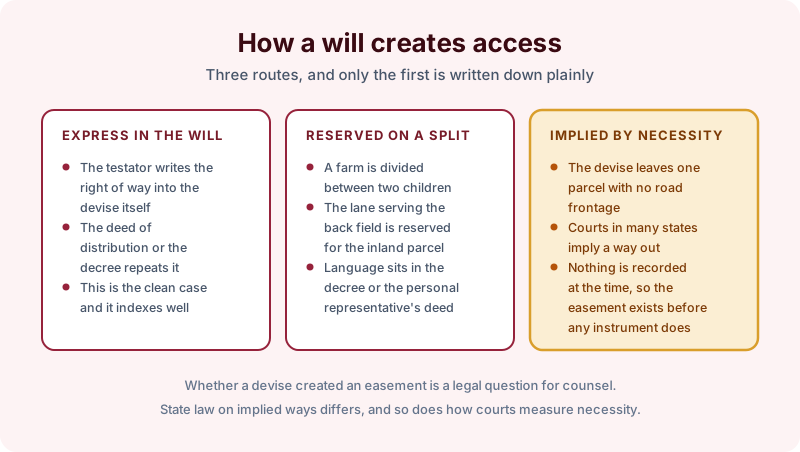
Express in the will. The testator writes the right of way into the devise, and the deed of distribution or the court decree repeats it. This is the clean case. The language is explicit, it usually reaches the land records, and it indexes against the parcels.
Reserved on a split. The estate divides a farm, and the lane serving the back field is reserved for the inland parcel. The reservation may sit in the decree of distribution, in the personal representative’s deed, or in both, and the wording is often brief.
Implied by necessity. The devise leaves one parcel with no road frontage at all, and courts in many states will imply a way out. Nothing is recorded when the right arises, so the easement exists before any instrument describing it does. How necessity is measured, and whether a merely inconvenient route defeats the claim, differ by state. Whether a particular devise created a right is a legal question, and it belongs to counsel rather than to the abstractor.
The grant and the chain sit in different files
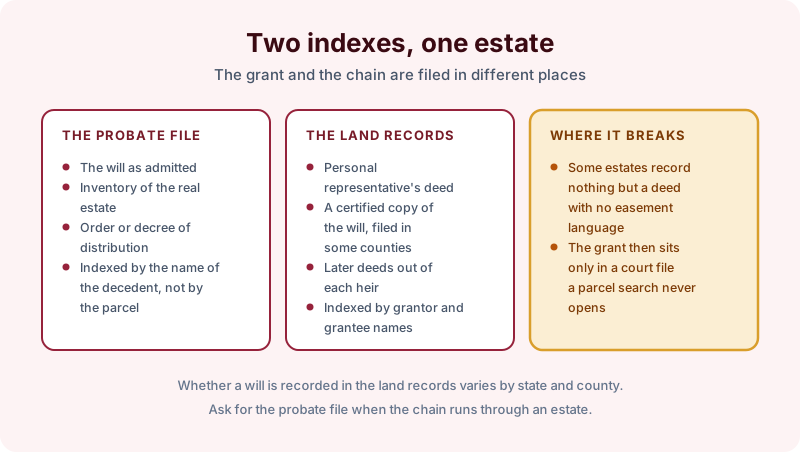
This is the practical problem. Probate records are indexed by the decedent’s name and held by the court. Land records are indexed by grantor and grantee and held by the recorder. In some states a certified copy of the will is recorded in the land records as a matter of course; in others it never is.
So an estate can leave a deed in the chain that conveys the parcel and says nothing about access, while the grant of access sits in a court file the parcel search never opens. The chain looks complete and the easement is still there.
What to ask for
When the chain runs through an estate, ask three things. Was a will or a decree recorded in the land records, and if so what does it say. Does the personal representative’s deed carry reservation or grant language. And were both parcels, the one claiming access and the one burdened, searched rather than only the subject lot.
That last point is the one most often skipped. An easement reserved for the back parcel is recorded against the front parcel’s chain as a burden, and a search that only looks at one side will miss it in one direction or the other. The 30-year term is usually the right depth when a mid-century estate division is suspected, because the split often predates the current owners by two generations.
What the search covers, and where it stops
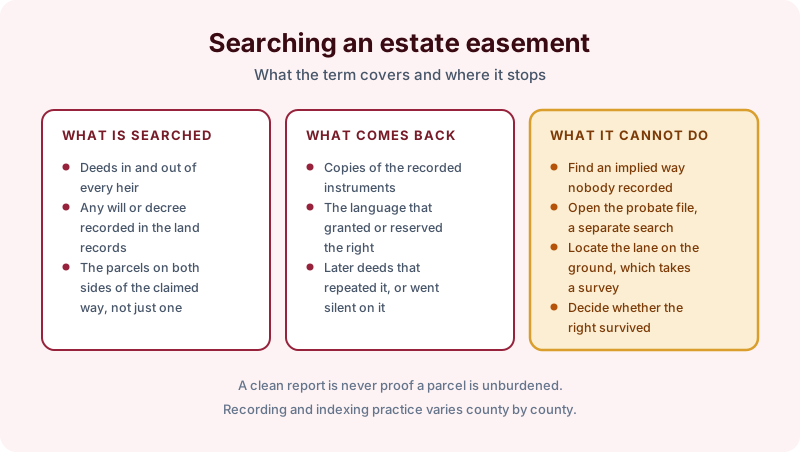
The search reports the deeds in and out of every heir, any will or decree recorded in the land records, and the language that granted or reserved the right, with copies of the instruments. It does not open the probate court file, which is a separate search, and it cannot find an implied way nobody ever recorded. It is not a survey and does not locate the lane on the ground. A clean report is never proof that a parcel is unburdened, and recording and indexing practice varies county by county. The types of easements page sets out the categories, and easements and inherited property in probate covers the estate administration side.
The takeaway
An estate in the chain is a flag, not a gap. Search both sides of the claimed way, ask whether the will or decree was recorded locally, and expect that an implied way of necessity will leave nothing to find. Reports come back in 2 to 3 business days.
Start the order online, or send us the address and the county and we will tell you which search term fits and what it would and would not cover before anything is ordered.