

· AFX Research
An Easement That Has Never Been Used, and Whether It Survives
Why decades of disuse rarely end a recorded easement on their own, the four ways one actually terminates, and what a search of the land records can and cannot settle.
Table of Contents
A buyer walks the property, finds a strip of overgrown ground where a title exception says there is a right of way, and reaches the obvious conclusion. Nobody has driven it in thirty years, so surely it is gone. It usually is not. An easement is a property right, and property rights do not generally lapse because the holder stopped exercising them. That is the same asymmetry that makes prescriptive easements and the record so counterintuitive, running the other way.
What disuse alone does
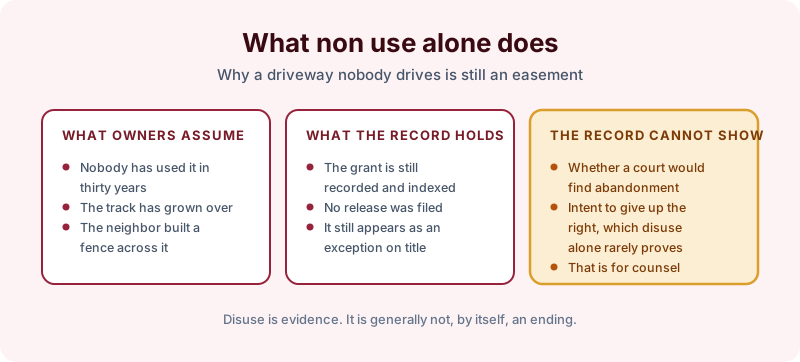
In most states, abandonment of an easement requires more than non-use. It generally requires evidence that the holder intended to give up the right, and courts have historically set that bar high. Letting a lane grow over, failing to maintain it, even standing by while the owner of the burdened land plants a hedge across it, has in many cases been held insufficient on its own.
The practical consequence is that the grant keeps showing up. It stays recorded, it stays indexed, and it stays on the title commitment as an exception, which is exactly where most people first meet it.
The four ways one actually ends
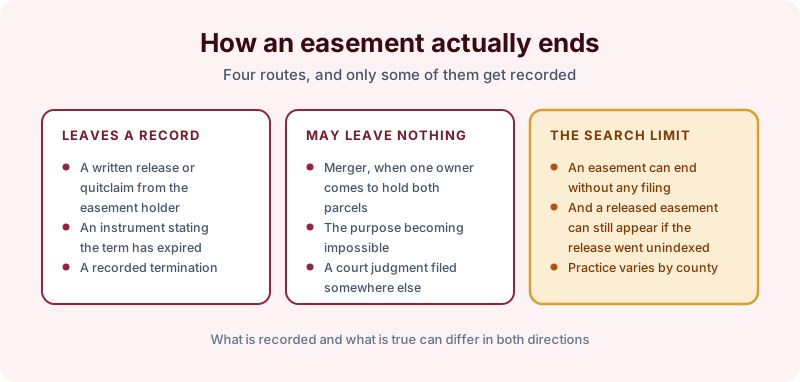
A release is the clean one. The holder of the benefited parcel signs an instrument giving up the right, it is recorded, and the burden comes off. A merger happens when one person comes to own both the benefited and the burdened parcel, at which point the easement generally has nothing left to do. Expiration applies where the grant stated a term or a purpose that has run out. Abandonment is the one everybody reaches for and the hardest to establish.
Only the first of those reliably leaves a document in the land records. A merger is visible only if you follow both chains and notice the common ownership. An expiration may be readable from the original grant’s own language. An abandonment may have been litigated in a court file that was never recorded against the property at all.
Searching one properly
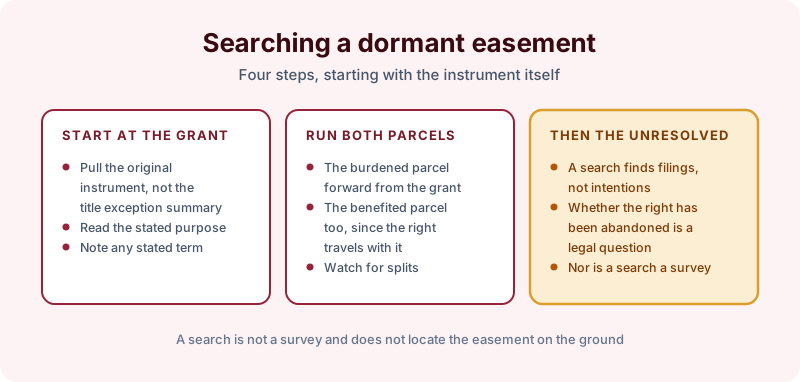
Start at the original instrument rather than the exception line on a commitment, because the exception is a summary and the summary drops the conditions. Read the stated purpose and any stated term. Then run both parcels forward, the burdened one and the benefited one, because an easement appurtenant travels with the benefited land and a later split of that parcel can multiply who holds the right.
What comes back is what was recorded and indexed in that county over the term searched. A search of the 20 year, 30 year or 50 year term is a search of a window, and a release recorded outside that window will not appear in it.
What a report cannot settle
A clean search is not proof that an easement is unburdened or extinguished. It reports what was found of record. Easements by prescription and by necessity are regularly created with no recorded instrument at all, so their absence from a report proves nothing about their existence. A search is not a survey and does not locate anything on the ground. And whether a particular set of facts amounts to abandonment is a legal conclusion for counsel, not a finding an abstractor makes.
Recording and indexing practice varies by county. A release filed in one jurisdiction may be indexed against the burdened parcel, and in another only against the holder’s name, which changes what a search run one way will surface.
The takeaway
Treat an unused easement as live until a recorded release, a merger in the chains, or a stated expiration says otherwise, and get the original grant in hand before anyone makes a decision. Our process pulls the instrument rather than the summary, and the easement search packages set out which term covers how far back. Reports come back in 2 to 3 business days, and the types of easements page explains which family you are likely dealing with.
Start the order online, or send us the address and the county and we will tell you which search term fits and what it would and would not cover before anything is ordered.