

· AFX Research
How Wide an Easement Is, and What the Grant Does Not Say
Many easement grants state a purpose but never a dimension. Where scope comes from when the instrument is silent, and what a records search can establish about it.
Table of Contents
A neighbor has a right of way across your land. The question that follows is almost always the same one, and it is almost never answered by the document everybody is looking at. How wide is it? Can they widen the gravel? Can they run a utility line down it? A surprising share of recorded easements, especially older ones, grant a purpose and stop there, which puts them in the same awkward family as blanket easements with no defined location.
What the grant measures, when it measures anything
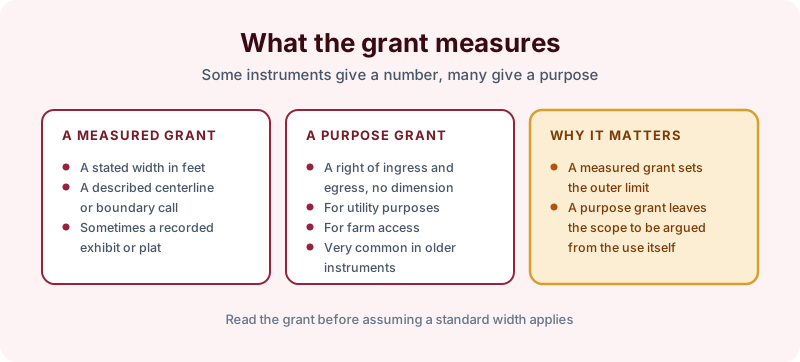
A measured grant gives you something to work with. Twenty feet in width, lying along the south line of the described parcel, or a centerline described by bearings and distances, or a reference to a strip shown on a recorded plat. The outer limit is set, and the argument moves to what may be done inside it.
A purpose grant gives you a right and no dimension. A right of ingress and egress. An easement for utility purposes. A way for farm access. These are extremely common in instruments drafted decades ago, when the parties knew perfectly well where the lane ran and saw no reason to write it down.
Where scope comes from when the instrument is silent
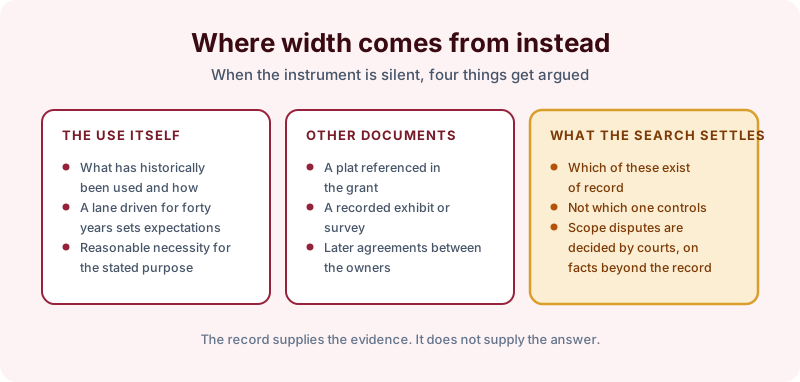
Courts have generally filled the gap with the idea that the easement carries what is reasonably necessary for its stated purpose, measured against how it has actually been used. A track that has been driven by passenger cars for forty years establishes a different expectation than one that has carried logging trucks.
Other documents feed the same question. A plat the grant refers to by name may show the strip even though the deed does not. A later agreement between the owners may have fixed the location or the width by consent. A deed in either chain may recite the easement in terms that are more specific than the original.
This varies by state more than most parts of easement law, and the outcome turns on facts that sit outside the land records entirely. Nothing here should be read as a rule that applies everywhere.
What the search actually produces
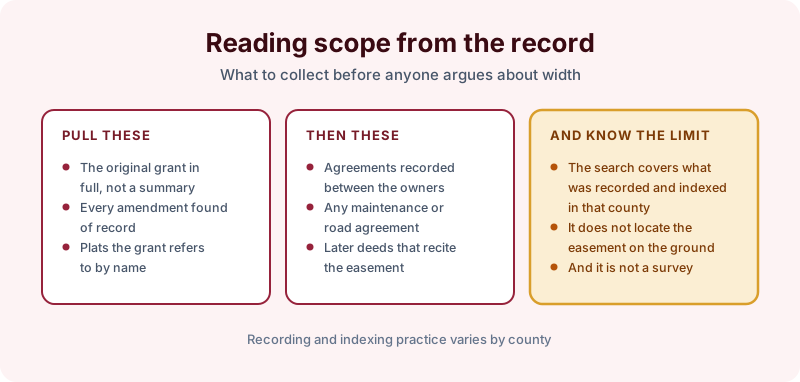
The useful deliverable is the full evidentiary set rather than a conclusion. The original grant in full, every amendment found of record, the plats it names, the agreements the owners recorded between themselves since, and the later deeds that recite the easement in their own words.
That set is what counsel argues from, and assembling it is ordinary abstracting work. The easement search packages differ in how far back they reach, which matters here because the instrument that answers a scope question is often the oldest one in the file. Reports come back in 2 to 3 business days.
The limits, which are real on this question
A records search reports what was recorded and indexed in that county over the term searched. On a scope question specifically, three limits bite hard.
It does not locate the easement on the ground. That is a surveyor’s work, and where the dispute is about whether the gravel has crept six feet north, a survey is the instrument that answers it, not an abstract.
It does not capture use. How the way has been used, by whom, and for how long is evidence that lives in testimony, photographs and aerial imagery rather than in the recorder’s office.
And it does not decide scope. Whether a particular width is reasonably necessary for a stated purpose is a legal conclusion, reached by a court on facts, and an abstractor does not reach it. Recording and indexing practice varies by county, so even the question of which instruments a search will surface is local.
The takeaway
When a grant states no width, stop looking for the number in the deed and start assembling everything the record holds around it. That set is what our process is built to deliver, the types of easements page explains which family the grant belongs to, and the guarantee covers the search itself.
Start the order online, or send us the address and the county and we will tell you which search term fits and what it would and would not cover before anything is ordered.