

· AFX Research
Who Had the Authority to Grant the Easement on Your Property
A recorded easement signed by the wrong person still sits in the index, and the chain of title on the grant date is what shows whether the signer could bind the land.
Table of Contents
A recorded easement looks settled. It has a notary stamp, a recording date, an instrument number, and a description of exactly what the holder may do. What it does not carry on its face is proof that the person who signed it owned enough of the property to give it away. That question is answered by the chain of title on the date of the grant, and it is one of the more useful things an easement search produces.
Who could sign, and what their signature reached
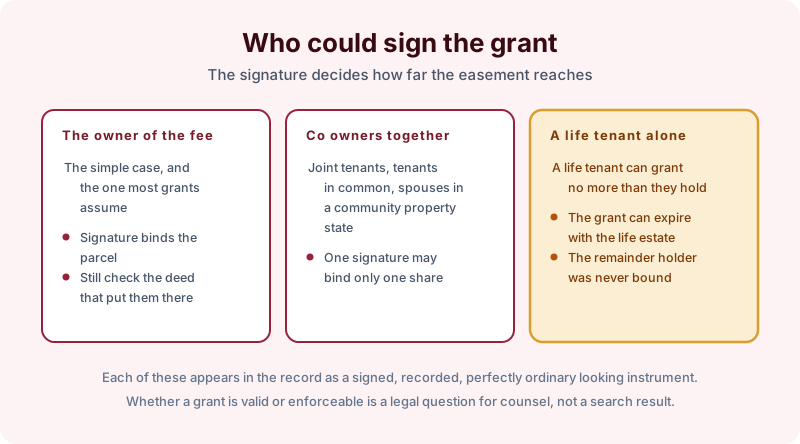
The simplest case is an owner of the fee signing alone, and most grants assume it. Co ownership complicates it immediately. Joint tenants, tenants in common and spouses in a community property state hold shares, and a grant signed by one of several owners may reach only that owner’s interest rather than the whole parcel.
A life tenant is the case that surprises people. Someone holding a life estate can grant no more than they hold, so an easement they sign can end when the life estate does, leaving the remainder holder with a parcel that was never burdened. That intersects with easements and inherited property in probate, where the same interests come apart in a different order.
Each of these produces a document that looks entirely ordinary in the index. Nothing about the instrument announces the problem. The defect only appears when somebody runs the chain back to the date on the grant and compares the signature against the owners of record that day.
When the owner is not a person
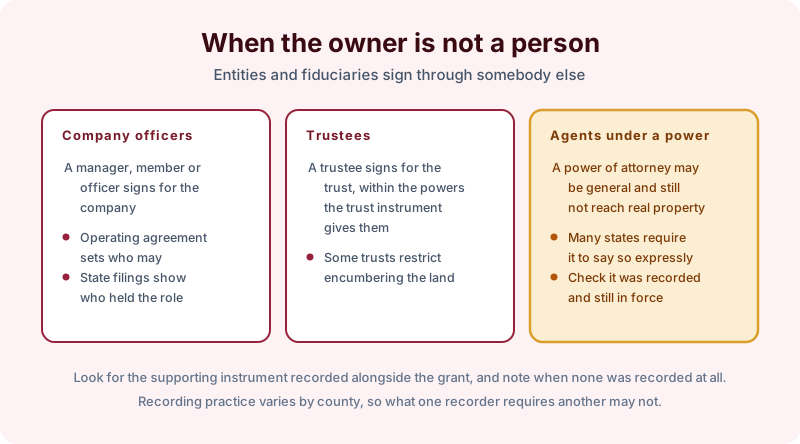
Entities and fiduciaries sign through somebody, and the somebody matters.
A company signs through a manager, member or officer, with the operating agreement or bylaws deciding who may bind it and state filings showing who held the role on that date. A trustee signs for a trust within the powers the trust instrument grants, and plenty of trusts restrict encumbering real property or require a co trustee to join. An agent under a power of attorney is the one most often taken for granted, because a general power may still fail to reach real property unless the state’s rules are satisfied, and many states require express language.
The practical move is to look for the supporting instrument recorded alongside the grant. A trustee’s certificate, a corporate resolution, a recorded power of attorney, a spousal joinder. Note when one is there, when it is missing, and when it was recorded years after the grant it was supposed to support. Recording practice varies by county, so what one recorder demands at the counter another never asks for.
What the search can and cannot settle
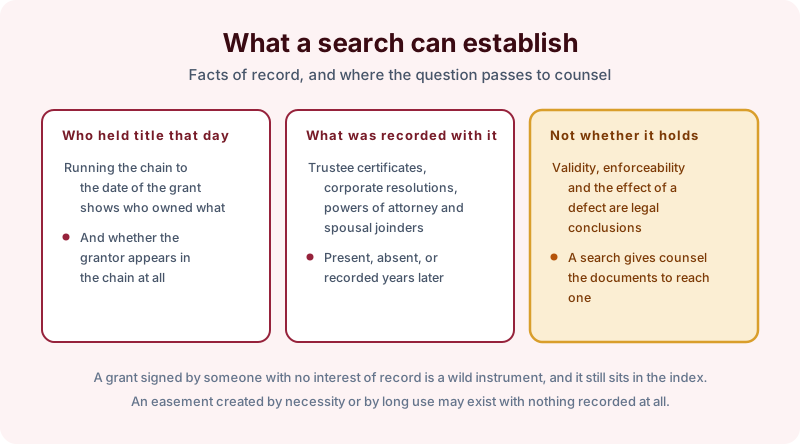
Running the chain back through the grant date shows who held title that day, in what shares, and whether the grantor appears in the chain at all. A grant signed by someone with no recorded interest is a wild instrument, and it still sits in the index where the next buyer will find it.
What the search does not do is decide anything. Validity, enforceability, the effect of a missing signature and whether a defective grant was later cured or ratified are legal conclusions for counsel in that state. A search is also not a survey and does not locate the easement on the ground, and because easements by necessity and by prescription arise with nothing recorded at all, a clean report is never proof a parcel is unburdened. Our process page covers what comes back and in what form. Turnaround is 2 to 3 business days.
The takeaway
When an easement looks wrong, the question to ask is not what it says but who signed it and what they held. Relocating or amending an easement runs into the same authority problem from the other direction. Start the order online, or send us the address and the county and we will tell you which search term fits and what it would and would not cover before anything is ordered.