

· AFX Research
A Recorded Release of Easement and What It Actually Covers
What a release of easement instrument does, why a partial release leaves most of a corridor in force, and what to confirm before treating a strip as given back.
Table of Contents
A release of easement is one of the more reassuring documents to find in a chain, and one of the easier ones to over-read. It is a recorded instrument in which the party holding an easement gives all or part of it back. The relief it provides is real, but it is bounded exactly by its own legal description, and a release sitting in the record is not the same thing as a parcel that is no longer burdened.
Who signs, and why that is the first question
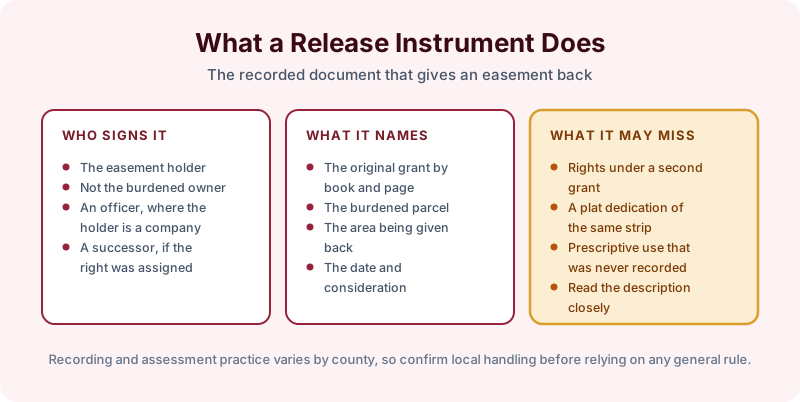
The signature belongs to the holder of the easement, not to the owner of the burdened land. The burdened owner is the beneficiary here. That sounds obvious until you are looking at a release signed by a company that is not quite the company named in the original grant, which happens constantly with utilities after forty years of mergers and asset sales.
If the right was assigned, the assignment should be in the record too, and the chain from the original grantee to the signer should close. An easement in gross that was assigned along the way can pass through several hands, and a release signed by the wrong successor is a weak document.
Partial releases are the normal case
Full releases happen, but a partial release is far more common. A utility abandons one segment of a corridor and keeps the rest. A developer gives back the portion of a construction easement that is no longer needed. The instrument then describes a specific strip, often by reference to an exhibit, and everything outside that description stays exactly where it was.
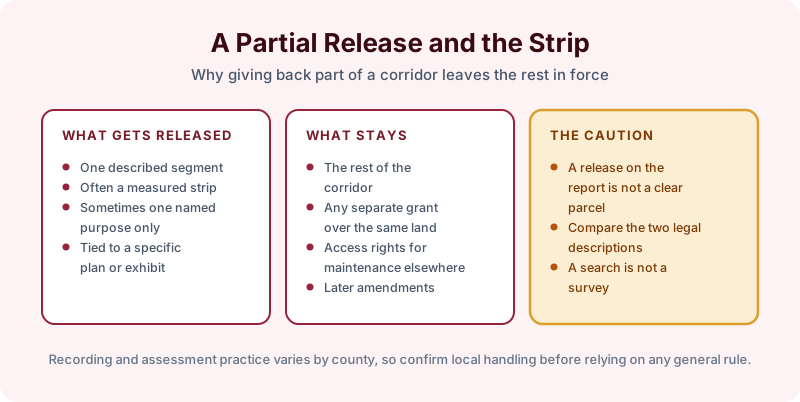
The practical move is to set the two legal descriptions side by side — the one in the original grant and the one in the release — and see how much ground is actually covered. If the release describes 20 feet and the grant described 50, the parcel is still burdened across 30 feet. That comparison is a reading exercise, not a surveying one, and where the descriptions are ambiguous a surveyor is the right next call.
What a release does not reach
A release speaks only to the instrument it names. It does not touch a second easement granted over the same ground by a different document, a dedication shown on a recorded plat, or a right established by long use that was never written down at all. Prescriptive rights and easements by necessity are created without any recorded instrument, so nothing in the recorder’s office will ever release them. That gap is covered in more detail in how an easement is terminated.
The instrument is not always called a release, either. Holders give rights back by quitclaim deed, by a termination of easement, by an abandonment, and occasionally by a letter that someone recorded because it was the only paper they had. The label on the first line matters far less than the operative words and the description underneath it, so read the body rather than the caption.
Counties also differ in where a release lands. Most index it against the burdened parcel, but a release recorded in the wrong county, or indexed only under the utility name, will not surface in an ordinary parcel search.
What the search reports
A 20 year, 30 year or 50 year easement search reports the easement instruments found of record for the parcel and term you specify, including grants, amendments, assignments and releases, with copies attached. Turnaround is 2 to 3 business days.
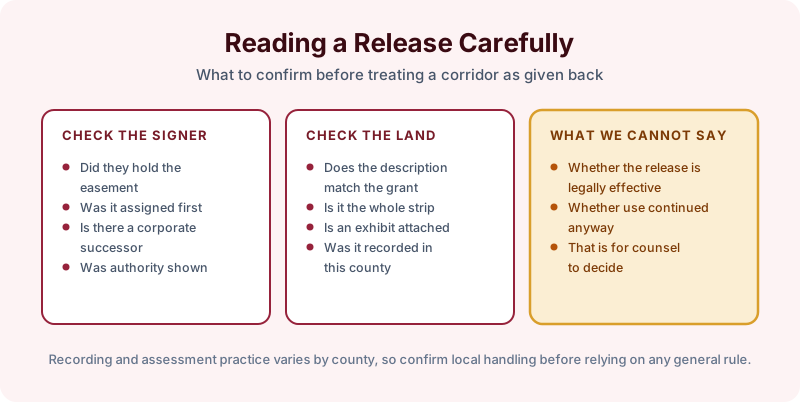
What it does not do is rule on whether a release worked. Whether a signer had authority, whether a description is sufficient, and whether the right survived anyway are legal conclusions that belong to counsel in that state. An abstractor reports what the record contains and flags what does not line up.
The takeaway
Treat a release as a document to be read rather than as a result to be accepted. Confirm who signed it, compare its description against the original grant, and remember that unrecorded rights are untouched by anything in the recorder’s office. Start the order online, or send us the address and the county and we will tell you which search term fits and what it would and would not cover before anything is ordered.