

· AFX Research
Assignments of Easements in Gross and What the Record Shows
Why an easement held by a company has no benefited parcel to index against, the four ways it changes hands, and how a search traces it forward to today.
Table of Contents
Most easement questions start with two parcels, one burdened and one benefited, and the record holds a handle on each. An easement in gross has only one. It belongs to a person or a company, not to a neighboring tract, and when that company is bought, merged, renamed or wound up, the right can move without a single instrument landing in the county where the land sits. Our note on easement appurtenant versus easement in gross sets out the distinction. This one is about what happens to the right afterward.
What an easement in gross is
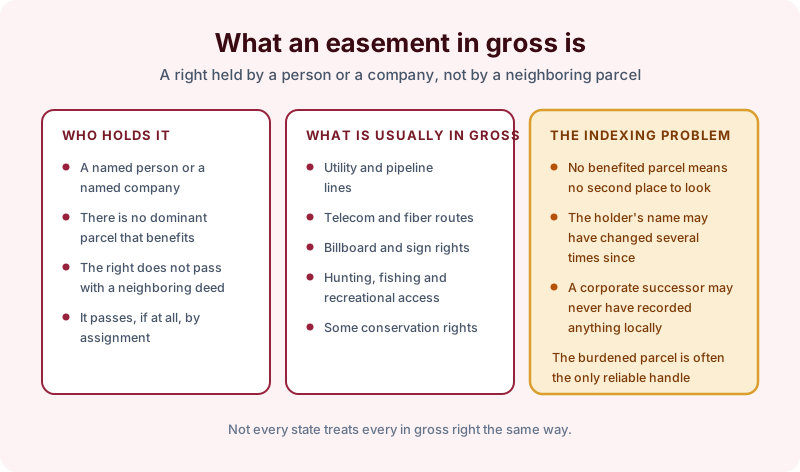
The holder is a named person or a named company. There is no dominant parcel, so the right does not pass automatically with a neighbor’s deed, and it moves only by assignment or by something that operates like one.
Most of the rights people actually encounter are in gross. Utility and pipeline lines. Telecom and fiber routes. Billboard rights. Hunting, fishing and recreational access. Some conservation rights, depending on how the instrument and the state statute are written.
The indexing consequence is the whole problem. With no benefited parcel there is no second place to look, the holder’s name may have changed several times, and a corporate successor may never have recorded anything in that county at all. The burdened parcel is usually the only reliable handle you have, which is why a search run against the land rather than against a company name is the one that finds these. Our page on types of easements sets out the rest of the family.
How the right changes hands
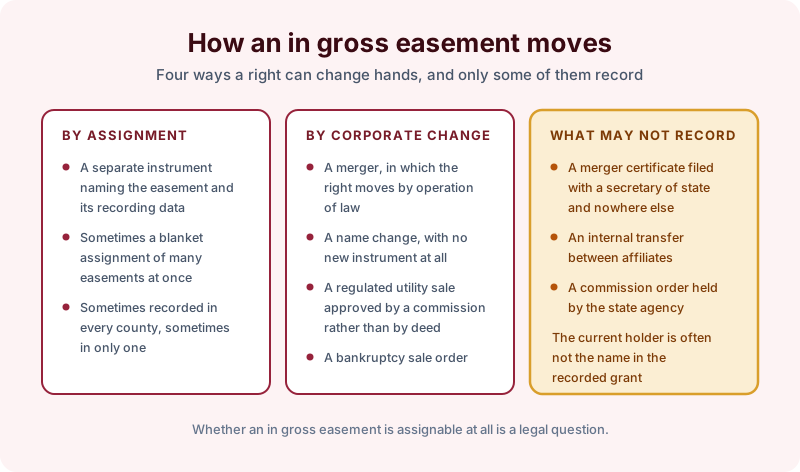
An outright assignment is the easy case. A separate instrument names the easement and cites its recording data, and the only wrinkle is that a blanket assignment covering hundreds of easements at once may be recorded in some counties and not others.
Corporate change is harder. A merger moves the right by operation of law, with nothing new recorded locally. A name change leaves no instrument at all. A regulated utility sale can be approved by a state commission rather than effected by deed. A bankruptcy sale order can transfer a portfolio of easements in a proceeding that no county index reflects.
So the current holder is routinely not the name in the recorded grant, and the gap is not evidence that anything is wrong. Whether an easement in gross is assignable in the first place is itself a legal question, and the older commercial and recreational ones are where that argument tends to live. This is the same succession problem that shows up in our note on easements when the utility that holds them is acquired.
Tracing one forward in a search
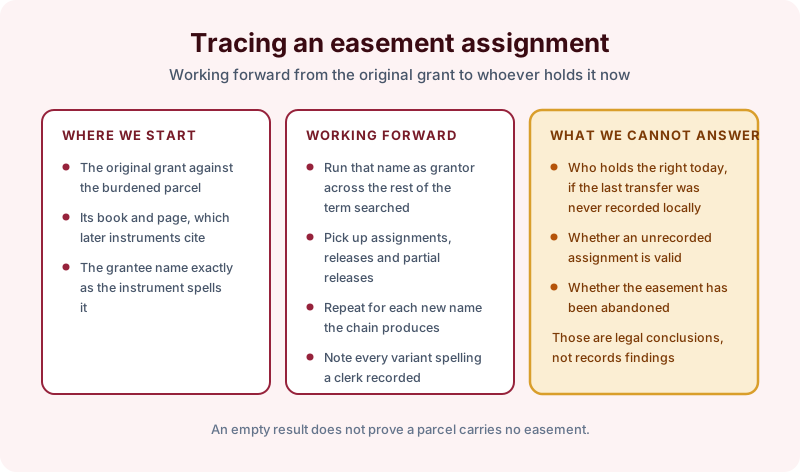
We start at the original grant found against the burdened parcel, take its book and page, and take the grantee name exactly as the instrument spells it, because the clerk indexed what was typed rather than what was meant.
Then we work forward. Run that name as grantor across the rest of the term searched, pick up assignments, releases and partial releases, and repeat the exercise for every new name the chain produces. Variant spellings go in the same pass, since an abbreviation in one instrument and a full corporate name in the next are the ordinary case rather than the exception.
What we cannot answer is who holds the right today when the last transfer was never recorded locally, whether an unrecorded assignment is valid, and whether the easement has been abandoned. Those are legal conclusions. Recording and indexing practice varies by county, a records search reports what was found of record, and an empty result does not prove a parcel carries no easement, since prescriptive and implied rights often have no instrument behind them.
The takeaway
If a line crosses the property and the grant names a company that no longer exists, the right has probably not gone anywhere. Search the land, trace the names forward as far as the record carries them, and then let counsel work out who you are actually dealing with. Start the order online, or send us the address and the county and we will tell you which search term fits and what it would and would not cover before anything is ordered. Reports run 2 to 3 business days.