

· AFX Research
What Happens When an Easement Has a Bad Legal Description
A recorded easement whose description does not close, names the wrong parcel, or gives no route at all still burdens the land. What fixes it, and what a search can show.
Table of Contents
An easement turns up in a search, the parties agree it exists, and nobody can say where it runs. The description does not close, or it refers to a plat that was never recorded, or it says simply that the right crosses the lands of the grantor. This is more common than it should be, particularly on grants written before the 1970s, and it is a different problem from the one in blanket easements with no defined location — a blanket easement is vague on purpose, while this one was meant to be specific and failed.
Four ways the words fail
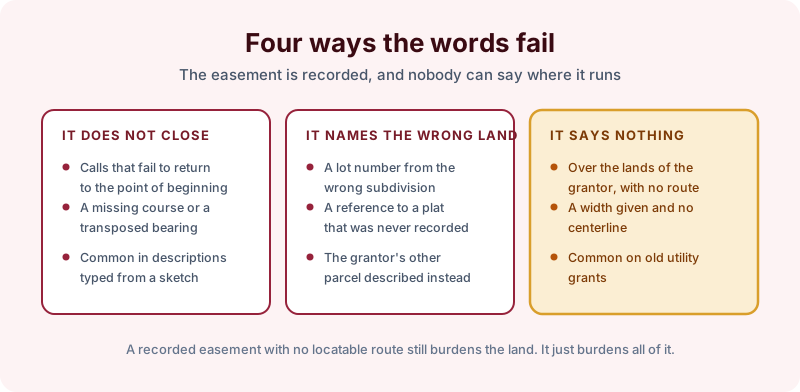
It does not close. The metes and bounds calls fail to return to the point of beginning, usually because a course was dropped or a bearing was transposed when somebody typed a surveyor’s sketch into a deed. A surveyor can often still plot the intent, and sometimes cannot.
It names the wrong land. A lot number from the adjoining subdivision, a reference to a plat that was drawn but never recorded, or the grantor’s other parcel described by mistake. These are the hardest to spot, because the description reads perfectly well. It simply describes somewhere else.
It describes nothing at all. A right to cross the lands of the grantor, with no route given, or a width stated with no centerline to hang it on. Old utility and pipeline grants do this constantly. The easement is real and the burden is real, and until somebody fixes it the burden is on the whole parcel rather than on a strip of it.
What actually fixes it
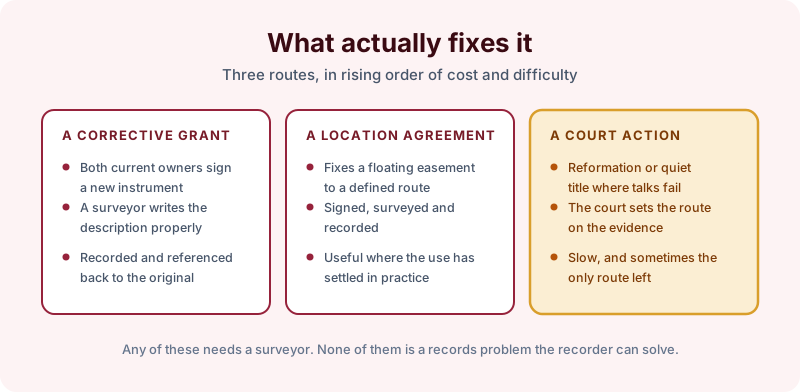
The cheapest route is a corrective grant. Both current owners sign a new instrument, a surveyor writes the description properly, and it is recorded with a reference back to the original. This works when everybody is cooperative and nobody has changed their mind about where the route should be.
Where the easement floats, a location agreement does the same job with a different name. It fixes the right to a defined route, which suits the common situation where the use has settled into one place over decades and both sides simply want that written down. It is close kin to the process in relocating or amending an easement.
Where talks fail, it becomes a court action for reformation or quiet title, and the court sets the route on the evidence. That is slow and expensive, and it is sometimes the only route left when one side benefits from the uncertainty.
All three need a surveyor. None of them is something a recorder can solve, because the office files documents rather than correcting them.
What the search gives you
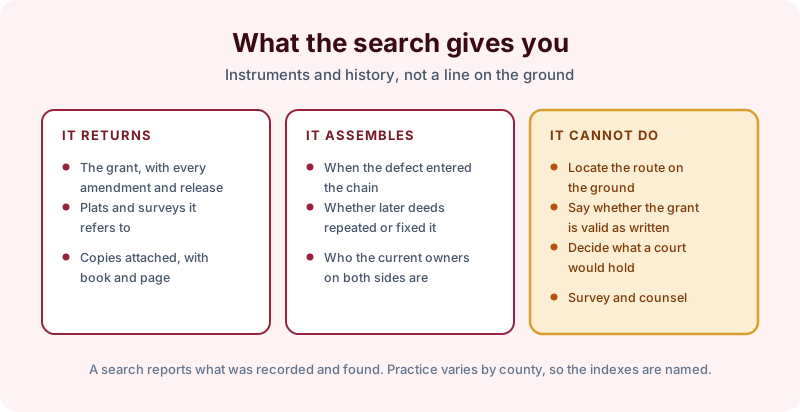
A search over the parcel returns the grant with every amendment and release, along with the plats and surveys it refers to, copies attached with book and page. More usefully it assembles the history, showing when the defect entered the chain, whether later deeds repeated it or quietly fixed it, and who holds both the benefited and the burdened land today. You need the second of those before anyone can sign a correction.
What it cannot do is locate the route on the ground, which is survey work, or say whether the grant is valid as written, which is counsel’s call. Recording and indexing practice varies by county, so our report names the indexes reviewed. Terms run 20, 30, and 50 years, and most searches come back in 2–3 business days; our process explains what each term reaches.
The takeaway
A defective description does not make an easement go away. It makes the burden harder to live with and harder to sell past. Get the recorded instruments and the plats they cite, find out who owns both parcels now, and bring in a surveyor before anyone drafts a correction. Start the order online, or send us the address and the county and we will tell you which search term fits and what it would and would not cover before anything is ordered.