

· AFX Research
Easements When the Utility That Holds Them Is Acquired or Merged
Why a utility easement outlives the company that took it, how mergers and name changes break the index trail, and what a search does to find a burden held under an old name.
Table of Contents
The company named on a fifty year old easement across your land may not exist anymore. It merged, it was bought, it reorganized in bankruptcy, or it simply changed its name — and in most of those cases the easement did not care. The right runs with the land rather than with the corporation, so the burden is alive even though the grantee on the paper is gone.
How an easement changes hands
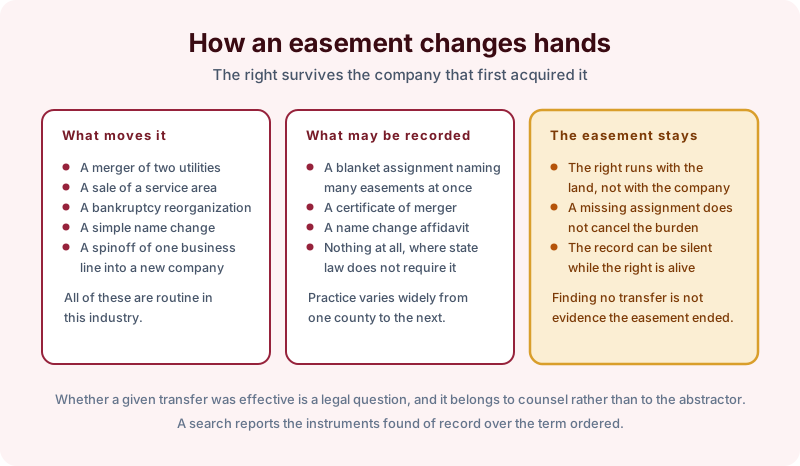
The events are ordinary ones in this industry. Two utilities merge. A service territory is sold. A business line is spun off. A cooperative consolidates with its neighbor. A holding company renames everything it owns.
What gets recorded afterward is far less predictable. Sometimes a blanket assignment is filed in each county, naming hundreds of easements at once. Sometimes a certificate of merger or a name change affidavit goes in. Sometimes nothing is recorded locally at all, because the transfer happened by operation of law and the state did not require a county filing.
That last case is the one that misleads people. Finding no assignment in the record is not evidence that the easement ended. It usually means the transfer simply left no local trace, and the right is exactly where it has always been — on the land. The same logic runs the other way when a company dissolves without a successor, which is the situation covered in easements when an association dissolves. Somebody may still hold the right even when nobody has used it in decades.
Names that no longer exist
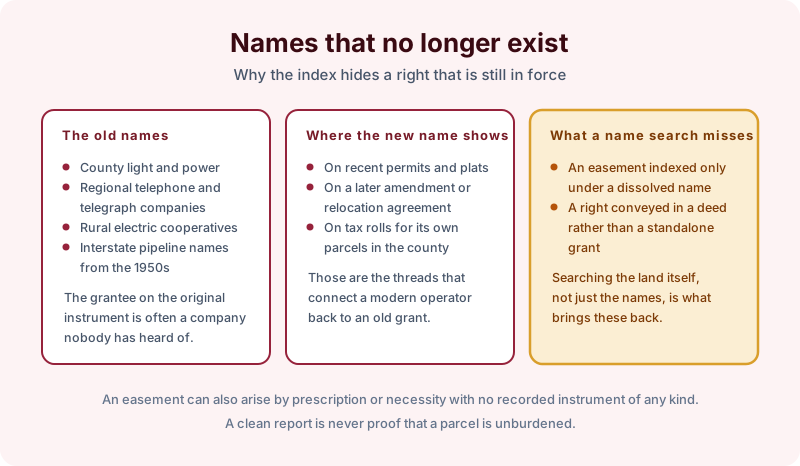
The grantee on an old instrument is frequently a company nobody recognizes. County light and power outfits, regional telephone and telegraph companies, rural electric cooperatives, pipeline names from the 1950s. If you search the index for the utility that bills you today, none of those will come up.
The modern name does leave traces. It appears on recent permits and plats, on later amendments and relocation agreements, and on the tax rolls for the parcels the utility owns outright in that county. Those are the threads that connect a current operator back to an old grant, and following them is ordinary utility easement work rather than anything exotic.
A name search on its own will miss an easement indexed only under a dissolved company, and it will miss a right conveyed inside a deed rather than by a standalone grant. That is one of the recurring reasons a recorded easement gets missed, and it is why searching the land matters more than searching the names.
How the search is run
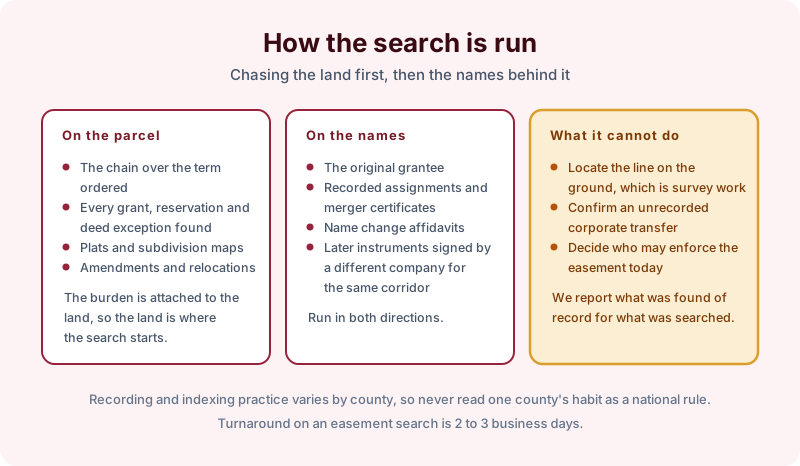
We start on the parcel and work the chain over the term ordered, pulling every grant, reservation and deed exception found, along with the plats and any amendments or relocations. The burden attaches to the land, so the land is where the trail is most reliable.
The names are run alongside it. The original grantee, recorded assignments and merger certificates, name change affidavits, and later instruments signed for the same corridor by a different company. Where a pipeline is involved the trail is often longer still, because interstate systems have changed hands repeatedly since the original grants, and the pattern described in our note on pipeline easements shows up on gathering lines as readily as on trunk lines. Our search packages differ mainly in how far back that work reaches, and on a corridor with a long corporate history the longer term is usually the honest choice.
What the search cannot do is locate the line on the ground, confirm an unrecorded corporate transfer, or decide who may enforce the easement today. Those first two are survey and corporate questions; the third belongs to counsel.
The takeaway
Recording and indexing practice varies by county, so no habit described here should be read as a national rule. Prescriptive easements and easements by necessity are often created without any recorded instrument, which means a clean report is never proof a parcel is unburdened. Turnaround is 2 to 3 business days. Start the order online, or send us the address and the county and we will tell you which search term fits and what it would and would not cover before anything is ordered.