

· AFX Research
Building On or Near an Easement: What the Record Controls
What an easement strip usually stops you doing, why a building permit is not the holder consenting, and the order to work in before anything gets poured.
Table of Contents
The addition is drawn, the contractor is booked, and somebody mentions there is a utility easement along the side of the lot. The useful question at that point is not whether you can build. It is what the recorded instrument says, because that document, and not the local custom or the neighbor who did the same thing in 2015, is what actually controls. Our guide to utility easements covers who holds these rights; this one is about building around them.
What the strip usually restricts
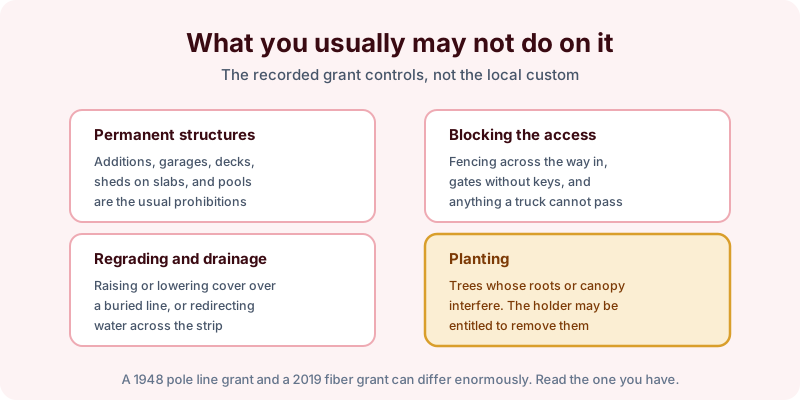
Most grants converge on four restrictions. Permanent structures over the strip: additions, garages, decks, sheds on slabs, pools. Blocking the access: fencing across the way in, gates without keys, anything a service truck cannot get past. Regrading and drainage: raising or lowering the cover over a buried line, or redirecting water across the strip. And planting, where roots or canopy may interfere and the holder is often entitled to remove what was planted.
How strictly any of that applies depends entirely on the document. A 1948 pole line easement and a 2019 fiber grant can read very differently, and blanket easements written across a whole parcel with no stated width behave differently again. That is why we attach the instruments rather than summarizing them: the terms are the substance, and a one-line index entry telling you an easement exists cannot answer whether a deck may sit on it.
A permit is not the holder’s permission
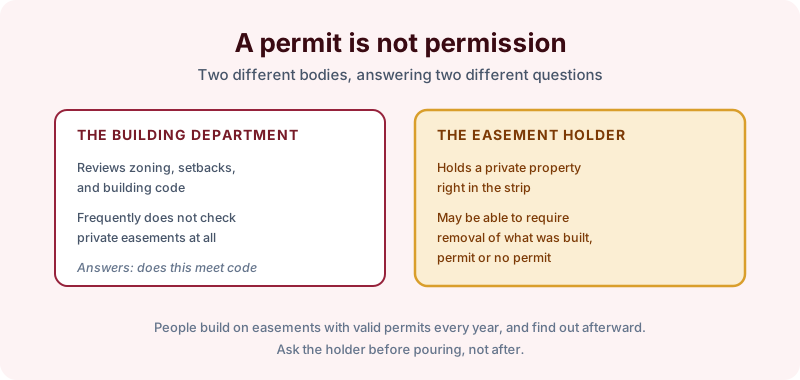
This is the misunderstanding that costs the most money. A building department reviews zoning, setbacks, and code compliance. In many jurisdictions it does not check private easements at all, and issuing a permit is not a finding that the work is clear of them.
An easement is a private property right. The holder may be able to require removal of what was built over it regardless of what permit was issued, and the cost of that lands on the owner who built. People do this every year with entirely valid permits and find out when a crew arrives needing access.
The order to work in
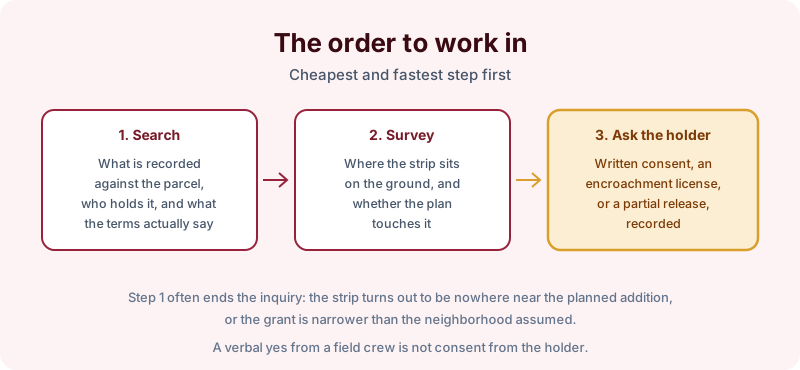
Search first. It is the cheapest and fastest of the three steps, and it frequently ends the inquiry: the strip turns out to sit nowhere near the planned addition, or the grant is narrower than the neighborhood assumed. You learn what is recorded, who holds it, and what the terms permit.
Then survey. A records search does not locate anything on the ground. Where the search shows a burden that might matter, a surveyor establishes whether the plan actually touches it. The two are complements, and doing them in this order means you only pay for the survey when there is something to locate.
Then ask the holder. Where the work does encroach, the routes are written consent, an encroachment license, or a partial release of the affected portion, and the ones worth having are recorded. A verbal yes from a field crew is not consent from the utility, and it will not bind them later.
Bear in mind too that a clean report is not proof the parcel is unburdened. Prescriptive easements and easements by necessity arise without any recorded instrument, so pair the search with a look at what is actually being used across the property.
Reaching far enough back
One practical point specific to this situation: the grant is often much older than the house. Pick a search term against the age of the parcel rather than the age of the structure, since an easement granted in 1954 is invisible to a search covering only the last twenty years. The search terms differ mainly in that depth, and our process page covers the 2 to 3 business day turnaround.
The takeaway
Read the instrument before you read the plans, treat the permit and the holder’s consent as two separate approvals, and work in the order search, survey, ask. Start the order online, or send us the address and the county and we will tell you which search term fits and what it would and would not cover before anything is ordered.