

· AFX Research
Easements and Mortgage Subordination, and Why Order Matters
An easement granted over mortgaged land can be wiped out at a foreclosure sale. What a subordination agreement does, and what the record shows when none was taken.
Table of Contents
Two parcels share a driveway under an easement signed in 2011. In 2026 the lender on the burdened parcel forecloses, and the buyer at the sale tells the neighbor to stop using it. That outcome is not a mistake and it is not unusual. It turns on which instrument reached the recorder first, and it is the quieter half of the question raised in do easements survive a tax sale or foreclosure.
Why the order of recording decides
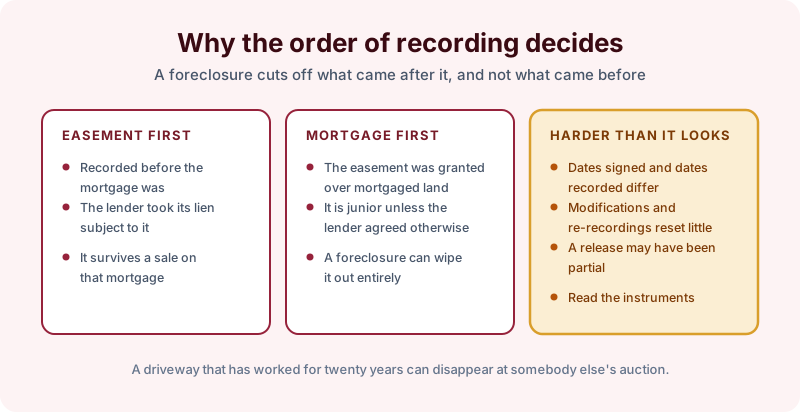
If the easement was recorded before the mortgage, the lender took its lien over land that was already burdened. The easement generally survives a sale on that mortgage, because the lender never had a position ahead of it.
If the mortgage came first, the easement is junior. A grantor who has already mortgaged the land can only grant what they still hold free of the lien, so a foreclosure on the senior mortgage can extinguish the easement entirely — and the buyer at that sale takes the land without it.
Working out which came first is less obvious than it sounds. The date a document was signed and the date it was recorded are frequently months apart, a modification or a re-recording does not necessarily reset anything, and a release may have been partial. The dates on the instruments are the answer, and reading them is the work.
What a subordination agreement does
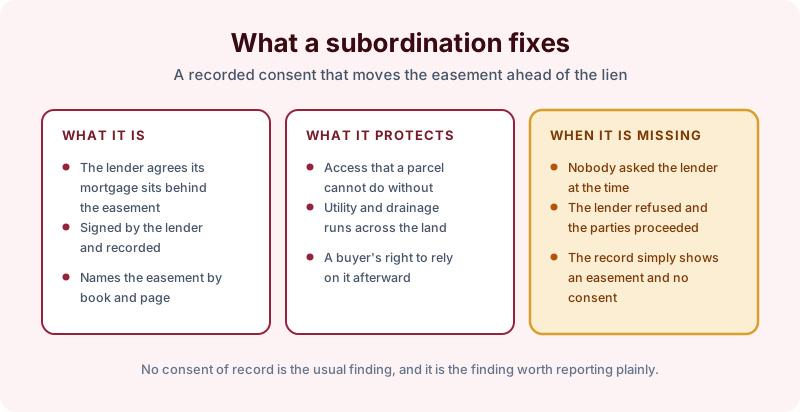
The fix is a subordination agreement, sometimes called a consent to easement. The lender signs a recorded instrument agreeing that its mortgage sits behind the easement, usually naming the easement by book and page. From that point the easement is treated as senior and survives a foreclosure on that lien.
It is cheap to obtain at the time and almost impossible to obtain afterward, which is why it matters so much on the easements a parcel genuinely cannot do without. Access to a landlocked lot, a shared drive, a utility run, a drainage path. On a landlocked parcel in particular, losing the access easement at a neighbor’s foreclosure is close to losing the use of the land. Those are the ones a buyer will rely on, and the ones the title company will ask about.
What a search usually finds, though, is that nobody obtained one. The parties negotiated between themselves, the lender was never asked, and the record shows an easement with no consent anywhere near it. That is an ordinary finding rather than a defect in the search, and reporting it plainly is the point.
Checking the order on a parcel
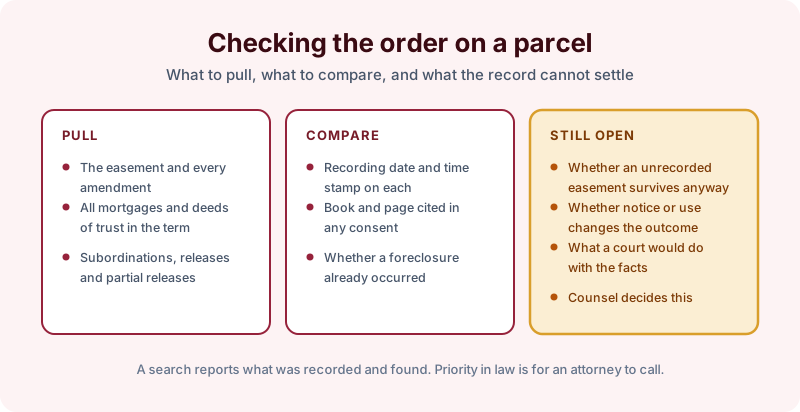
Pull the easement and every amendment to it, every mortgage and deed of trust recorded during the term, and any subordination, release, or partial release. Then compare recording dates rather than signature dates, check whether a consent cites the easement correctly by book and page, and establish whether a foreclosure has already run on that parcel.
Our terms run 20, 30, and 50 years, and the longer ones matter here because the mortgage you need to see may have been recorded long before the easement you are asking about. Our search packages set out what each term reaches, and most searches come back in 2–3 business days.
What the record cannot settle is the law. Whether an unrecorded easement survives anyway, whether a purchaser with notice is bound regardless of the index, and what a court would do with a particular set of facts are all questions for counsel. A records search is not a survey either, so it does not locate the easement on the ground, and a clean report is never proof that a parcel is unburdened.
The takeaway
When an easement matters enough to buy or lend on, check whether it predates the mortgage and whether anyone recorded a consent. Pull the instruments and compare the recording dates rather than trusting the signature dates, and treat a missing subordination as a question for counsel before closing. Start the order online, or send us the address and the county and we will tell you which search term fits and what it would and would not cover before anything is ordered.