

· AFX Research
Easements Created by a Recorded Development Agreement with a City
How a contract between a city and a developer ends up burdening individual lots years later, where it hides in the index, and what the exhibits actually control.
Table of Contents
Most easements arrive by a route a buyer can picture. A utility asks for one, a seller grants one, a plat draws one. Development agreements are different. They are contracts between a local government and a developer, recorded against a whole project, and the easements inside them can burden a lot that was sold three owners ago to somebody who never saw the document. They sit beside easements created by a subdivision plat as a second way the entitlement process writes itself into the land record.
What a development agreement is
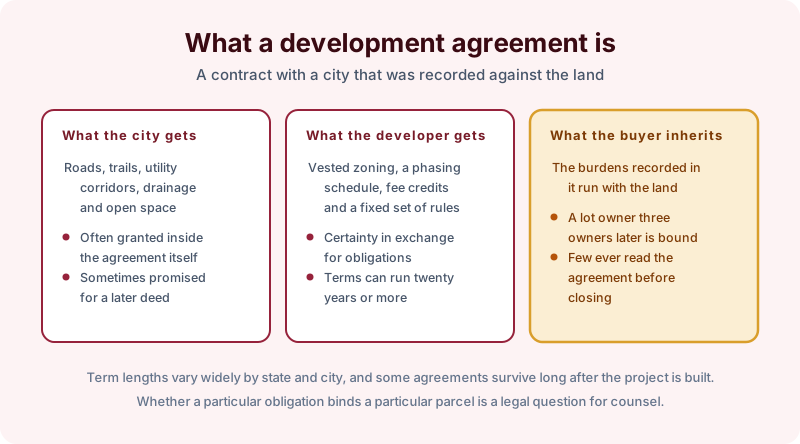
The trade is straightforward. The developer wants certainty, meaning vested zoning and a fixed set of rules that will not change halfway through a ten year build. The city wants infrastructure, meaning roads, trail connections, utility corridors, drainage areas and open space it would otherwise have to buy or condemn. Annexation, a rezoning to a planned unit development, or a large subdivision approval are the usual triggers, and the agreement is often signed years before the first lot is sold.
That bargain gets written down and recorded, and the recording is the point. A contract recorded against the land puts later buyers on notice, and the obligations inside it are drafted to run with the parcels rather than follow the developer out of town. Some of these agreements run for twenty years or more, and many are still in force long after the last house sold.
Why it is easy to record and easy to miss
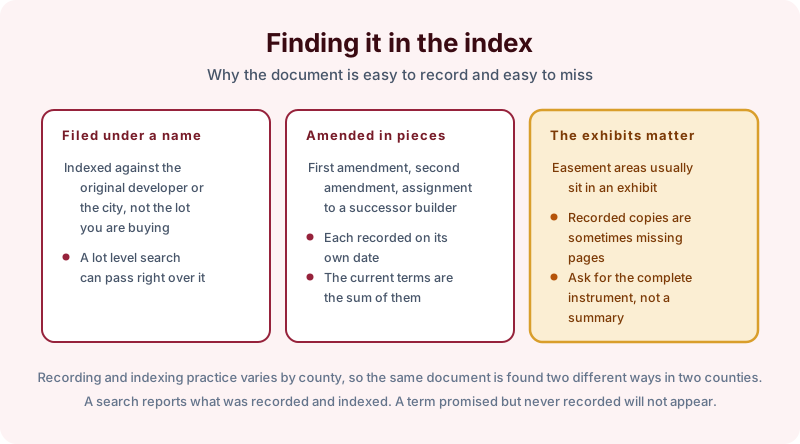
The document is typically indexed under the original developer and the municipality, not under the lot you are buying, which is exactly the situation a name based index handles badly. A search scoped tightly to the current owner can pass over it entirely.
Then it moves. A first amendment extends the phasing schedule, a second amendment relocates a trail corridor, an assignment transfers the whole thing to a successor builder, and each of those is recorded on its own date under its own names. The terms in force today are the sum of the original and everything that followed, which is why pulling only the first document is a common and expensive shortcut.
The easement descriptions usually live in exhibits. Recorded copies are occasionally short a page or two, and recording and indexing practice varies county by county, so the way a complete instrument is assembled in one county is not how it is done in the next. Ask for the full recorded instrument rather than a summary. The types of easements page covers how these compare with the more familiar forms.
What it means for an individual parcel
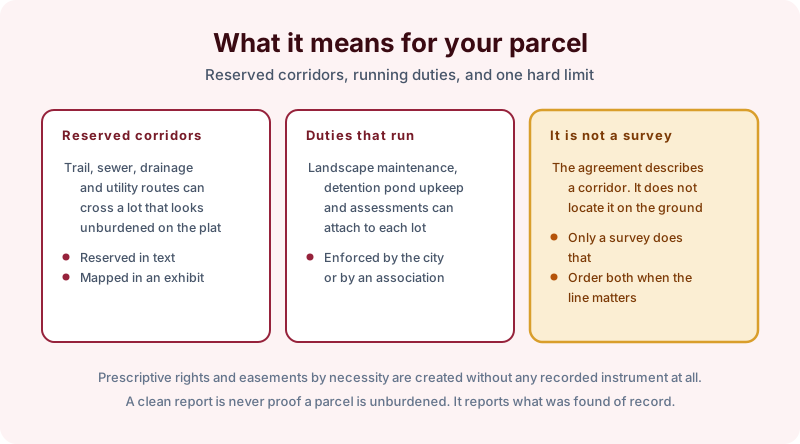
Two kinds of burden show up. Reserved corridors are the obvious one, where a trail, a sewer line, a drainage swale or a future road alignment crosses ground that looks completely unburdened on the subdivision plat. Running duties are the quieter one, covering landscape maintenance along a frontage, detention pond upkeep, or assessments collected by the city or by an association formed under the agreement.
Neither of those tells you where anything sits. An agreement describes a corridor in words and maps it in an exhibit at a scale that was never meant for construction. A search is not a survey and does not locate an easement on the ground, so when the exact line matters, order both. A clean report is also never proof that a parcel is unburdened, since easements by necessity and prescriptive rights arise with nothing recorded at all. Our note on easements created by dedication and acceptance covers a related path into the record.
The takeaway
If the parcel sits in a planned community, a master planned development or a recently annexed area, assume a development agreement exists and search for it by the developer’s name and the city’s, not only by the current owner. Start the order online, or send us the address and the county and we will tell you which search term fits and what it would and would not cover before anything is ordered.