

· AFX Research
Easements on Surplus Land Sold by a City or County Agency
What a surplus deed from a city, county or authority reserves, which rights can exist without any instrument, and how to work the record on a parcel that was public land.
Table of Contents
Surplus parcels are some of the most attractive land on the market. A closed school site, a strip left over when a road was widened, a well lot a water district no longer needs. They are also some of the most heavily burdened, because land that served a public purpose for fifty years tends to have collected rights the way a shoreline collects driftwood, and a fair number of those rights were never written down. The question is close to the one in our note on easements across federal and state land, but the answer sits in the county record rather than a federal one.
How the parcel got out of public hands
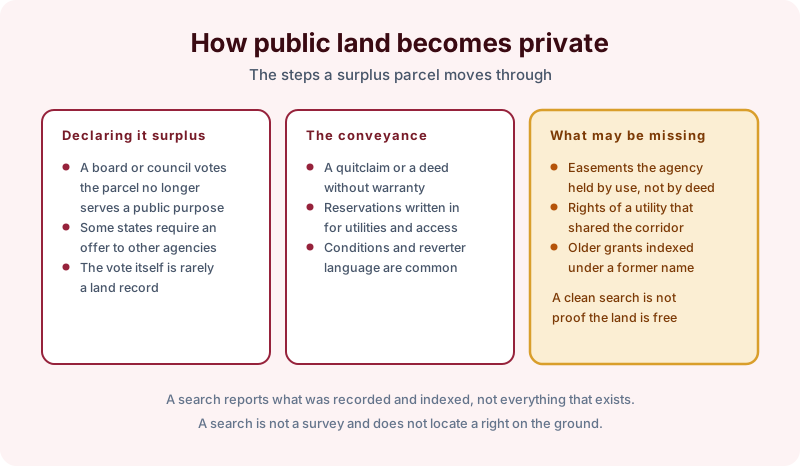
The first step is a declaration that the land is no longer needed. A board or a council votes, and in many states the agency has to offer the parcel to other public bodies before it can go to a private buyer. That vote lives in minutes and resolutions, and unless somebody records it, none of it reaches the land records.
The conveyance usually comes as a quitclaim or a deed without warranty. Agencies rarely warrant title, which means the deed transfers whatever the agency had and says nothing about what that was. Inside the deed you will often find reservations for utilities and access, and sometimes conditions on how the land may be used, with reverter language if a condition is broken.
What the deed does not list is the interesting part. A right the agency exercised for decades without a document, a utility that shared the corridor under a long forgotten permit, and older grants indexed under a name the agency has not used since the 1970s are all common, and none of them will appear because the agency never created a record of them.
Rights the seller keeps, and rights nobody wrote down
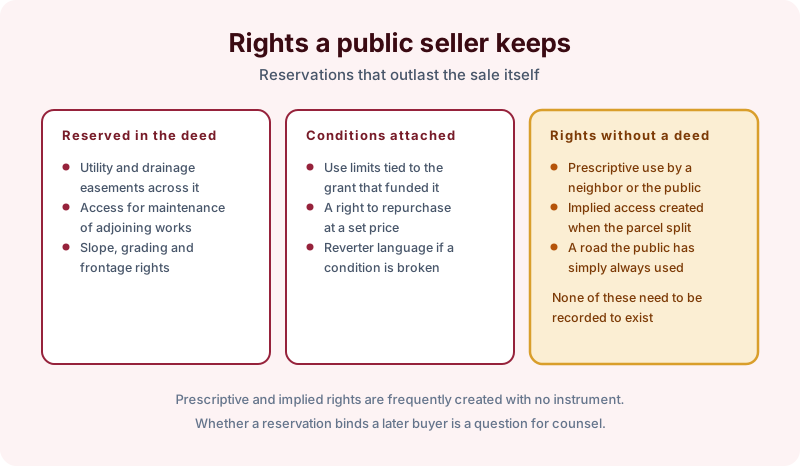
Reserved rights are the ones you can read. Utility and drainage easements across the parcel, access for crews maintaining adjoining works, slope and grading rights along a road frontage. These are usually described well enough to be located, and they bind whoever buys next.
Conditions are a second category. Where the land was bought with grant money, the funding program may limit what the parcel can be used for, and the agency may hold a repurchase right at a fixed price. A condition that is breached can, in some states, return title to the agency, so the words in the instrument matter more than the price did.
The third category is the one that spoils closings. Prescriptive use by a neighbor or by the public, implied access created when the parcel was split off, and a road the public has simply always driven are rights that can exist without a single recorded page. Our note on prescriptive easements explains why a clean report is never proof that a parcel is unburdened.
Working the record
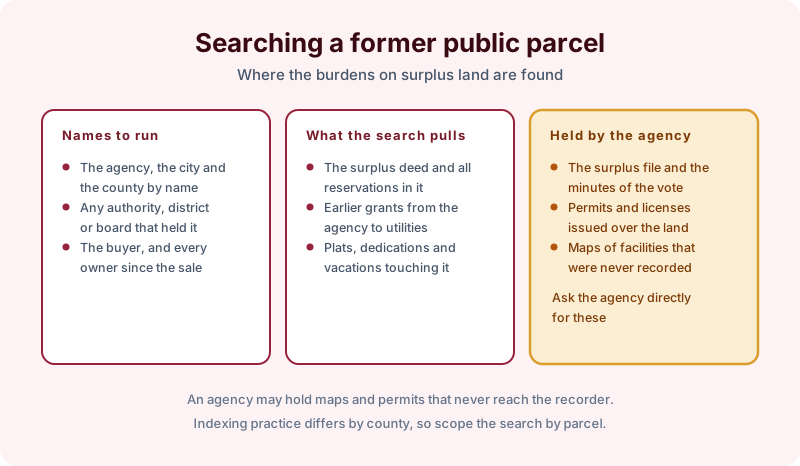
Run the names, not just the parcel. The agency, the city, the county, and every authority, district or board that has held the ground, because a grant made in 1958 is indexed under whatever that body was called then. Then run the buyer and each owner since, which is the ordinary easement search process applied to a longer list of names.
Within the term searched we pull the surplus deed and its reservations, earlier grants from the agency to utilities and telecoms, and the plats, dedications and vacations that touch the parcel. A 20-year search at $325 reaches recent conveyances and most utility work, and a 50-year search at $675 is the one that finds the mid century grants that tend to matter here. Turnaround is 2-3 business days either way.
The agency’s own file stays with the agency. Minutes, permits, licenses and facility maps are public records you can request, but they are not land records and we do not get them from the recorder.
The takeaway
Treat a former public parcel as burdened until the record and the agency both say otherwise, and remember that a search reports what was recorded rather than everything that exists. It is also not a survey, so it will not place a right on the ground. Start the order online, or send us the address and the county and we will tell you which search term fits and what it would and would not cover before anything is ordered.