

· AFX Research
Overlapping Easements in the Same Corridor, and Who Came First
Why one strip of land collects several easements, what the recording dates do and do not settle about priority, and why only a survey can say whether two strips overlap.
A corridor across a parcel rarely carries one easement. It carries whatever has been granted there since the first one was taken, which on an older property can mean a transmission line, a gas line, a water main, a fiber conduit and a neighbor’s driveway sharing roughly the same ground. Each of those was granted separately, and no single document describes the arrangement.
Why corridors fill up
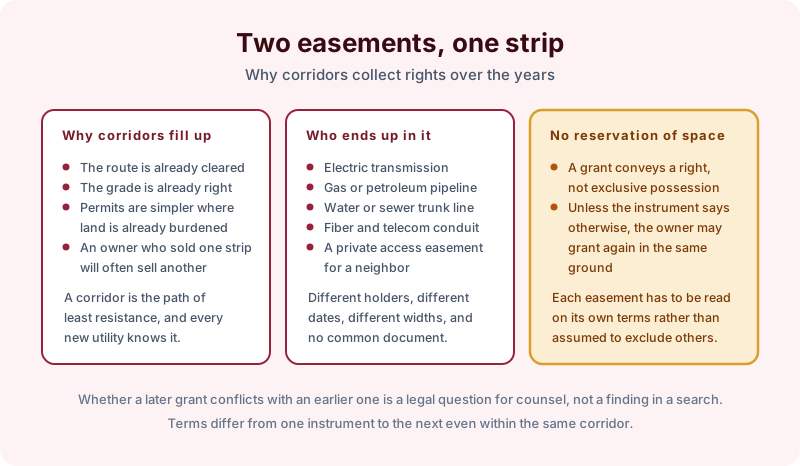
A cleared route with the right grade and an owner who has already agreed to one burden is the path of least resistance, and every utility planning a line knows it. Permitting is simpler where the ground is already encumbered, and the landowner who sold one strip will often sell another.
So the holders stack up. Electric transmission, a pipeline, a sewer trunk, telecom conduit, and frequently a private access easement serving a landlocked neighbor — different dates, different widths, different purposes, no common instrument. Fiber is the most recent arrival on most of these corridors, and it is frequently installed under an agreement with the existing pole or conduit owner rather than under a new grant from the landowner, which is one reason the arrangements described in telecom and fiber easements can be hard to see from the parcel side.
The piece most people get wrong is what a grant does to the ground. An easement conveys a right of use, not exclusive possession. Unless the instrument says otherwise, the owner remains free to grant again in the same strip, so a recorded easement does not reserve that land against the next one. Each grant has to be read on its own terms, which is the same discipline our note on types of easements sets out.
Which one came first
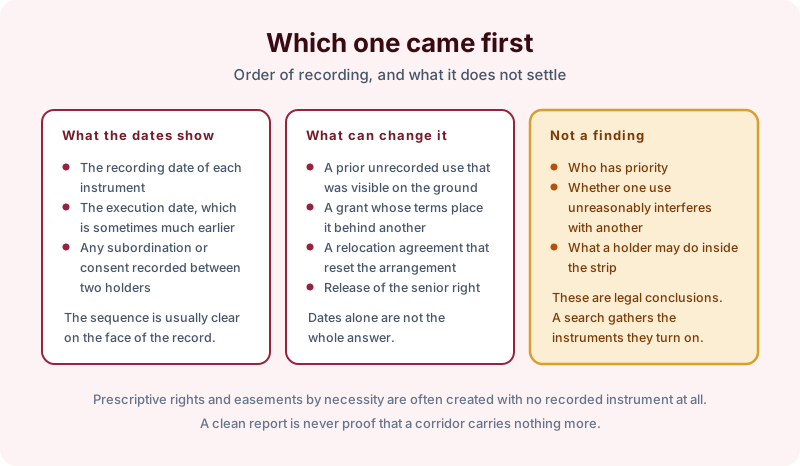
The record gives you a sequence. Every instrument carries a recording date, usually an execution date that may be considerably earlier, and sometimes a subordination or consent recorded between two holders who sorted the question out themselves.
The sequence is not always the answer. A prior unrecorded use that was visible on the ground can carry weight, a grant may place itself behind another by its own terms, a relocation agreement may have reset the arrangement entirely, and a senior right may have been released years ago. Our note on blanket easements with no defined location covers a related problem, where the senior right is real but its position was never fixed.
Who has priority, whether one use unreasonably interferes with another, and what a holder may do inside the strip are legal conclusions. A search gathers the instruments those questions turn on. It does not reach the conclusions, and an abstractor who offered one would be stepping outside the work.
Reading a crowded corridor
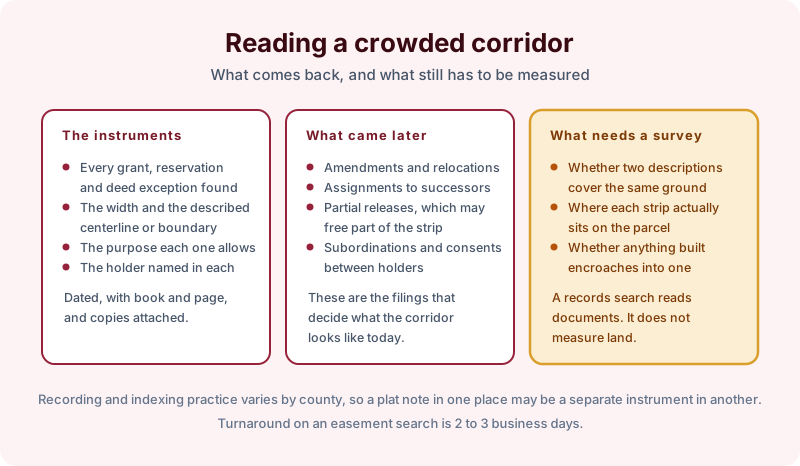
We report every grant, reservation and deed exception found over the term ordered, with the width, the described centerline or boundary, the purpose each one allows, the holder named, the date, the book and page, and copies attached.
Then we report what came after, because that is usually what decides the present shape of the corridor. Amendments and relocations, assignments to successors, partial releases that may have freed part of the strip, and subordinations or consents between holders. A corridor that looks crowded in the original grants is sometimes far simpler today, and the opposite happens just as often.
What still needs a survey is whether two descriptions actually cover the same ground, where each strip sits on the parcel, and whether anything built has encroached into one. A records search reads documents. It does not measure land, and our process says so before the order rather than after it.
The takeaway
Recording and indexing practice varies by county, so a right that appears as a plat note in one place is a separate recorded instrument in another. Prescriptive easements and easements by necessity frequently exist with no instrument at all, which means a clean report is never proof that a corridor carries nothing more. Turnaround is 2 to 3 business days. Start the order online, or send us the address and the county and we will tell you which search term fits and what it would and would not cover before anything is ordered.