

· AFX Research
Who Pays Property Taxes and Assessments on an Easement Area
Why the burdened owner normally stays on the tax roll for the whole parcel, where an easement can reach assessed value, and which office holds which record.
Table of Contents
An easement crossing your land feels like it should come off your tax bill, and the question comes up on almost every order where a corridor runs through the middle of a parcel. The general answer is that it does not, because an easement is a right of use rather than a transfer of ground. The useful answer is a little more layered, and most of it turns on which county office you are asking.
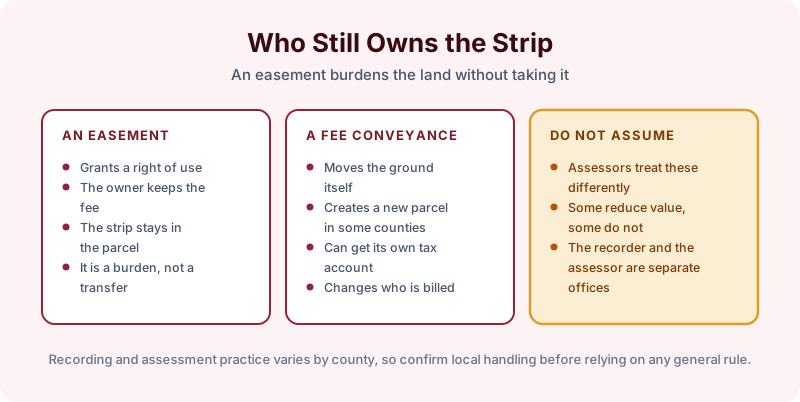
The burdened owner keeps the fee
When a utility takes an easement, the strip stays inside your parcel. You still own the ground under the line. What the utility has is a right to be there and to do specified things, and the grant usually spells out what you may not do in return, such as building or planting over it. Because the fee never moved, the parcel description on the tax roll does not change and the bill keeps covering the whole thing.
Compare that to a fee conveyance, where the strip is deeded away outright. In many counties that creates a new parcel with its own account, and the ground genuinely leaves your assessment. The documents can look similar at a glance, which is why the distinction described in easements reserved in a deed versus granted separately matters so much when reading a chain.
Where an easement can reach assessed value
Assessment is a separate question from ownership, and this is where local practice takes over. Some assessors do reflect a recorded encumbrance in value, particularly where a corridor makes a meaningful share of the lot unbuildable. Others apply standard methods that do not account for it at all, on the view that the land still has use. Neither approach is universal, and the only way to know is to ask the assessor in that county.
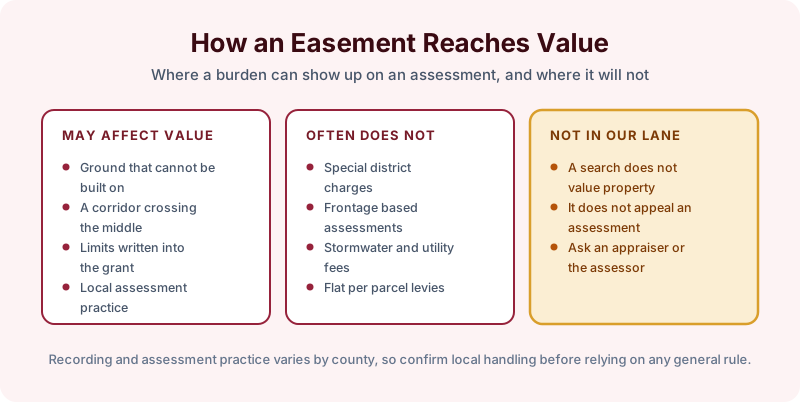
Special assessments tend to behave differently again. Charges levied by a drainage district, a sewer district or a lighting district are often calculated on frontage, area or a flat per parcel basis, and those formulas generally take no notice of who has the right to walk across the middle. A burdened parcel can carry the full charge regardless.
Two offices, two sets of records
The recorder holds the easement itself — the grant, any amendments, any release, and the plats that show a corridor. The assessor holds the parcel record, the value, the exemptions and the maps. The collector or treasurer holds the balance owed. They are separate offices with separate indexes, and a document in one is not automatically visible in the other.
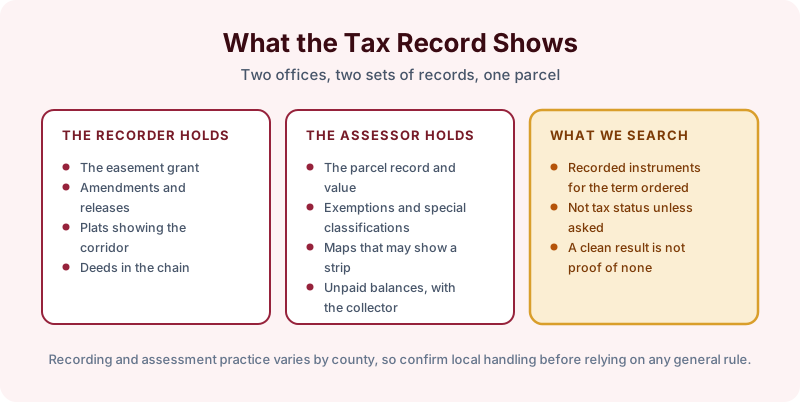
That split explains a frequent surprise. An assessor’s parcel map may draw a utility corridor that has no recorded grant behind it, because the map was built from a plan rather than from an instrument. It can also miss a recorded easement entirely. The map is a working tool, not a title record, and an easement that appears only on the survey raises the same issue from the other direction.
What our search does and does not cover
A 20 year, 30 year or 50 year search reports the recorded easement instruments found for the parcel and term you name, with copies, in 2 to 3 business days. It covers the recorder’s side. It is not a tax certificate, it does not value property, and it does not appeal an assessment. If the tax question is the one driving the deal, an appraiser and the county assessor are the right people, and we are happy to say so rather than stretch the report to cover it.
The takeaway
An easement burdens land without taking it, so the bill normally stays whole, while the effect on assessed value depends on local practice rather than on any general rule. Keep the recorder’s record and the assessor’s record separate in your head, because they answer different questions. Start the order online, or send us the address and the county and we will tell you which search term fits and what it would and would not cover before anything is ordered.