

· AFX Research
When an Easement Appears Only on the Survey and Not of Record
A surveyor drew a driveway, a pole line or a path across the parcel, the land records show nothing, and the closing is next week. What that gap means and how to work it.
Table of Contents
It is one of the more common calls we get. The survey came back with a dashed line across the back of the lot labeled as an apparent easement or a note about a driveway serving the neighbor, and the title work turned up no recorded instrument that matches it. Nobody is quite sure whether the buyer is taking a parcel with a right of way across it or a parcel with a neighbor who has been using it.
A survey line is not a record
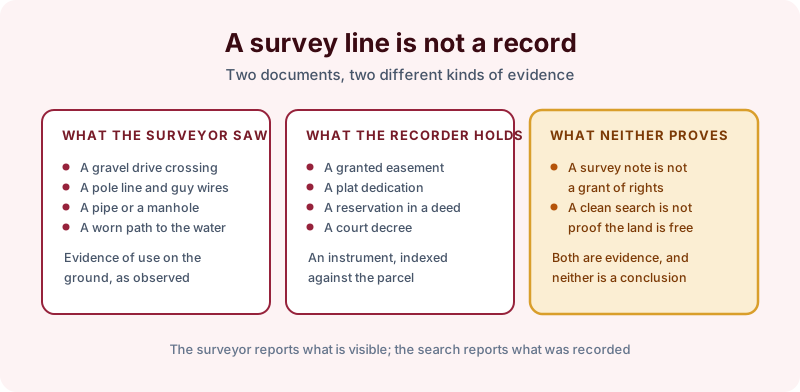
The two documents answer different questions. A surveyor reports what is visible and measurable — a gravel drive, a guy wire, a manhole, a worn path to the water — and will often note it as an apparent or possible easement precisely because they are describing a condition rather than a right.
A search of the land records reports what was recorded and indexed against the parcel over the term searched. It finds granted easements, plat dedications, reservations in deeds and court decrees.
Neither document, on its own, settles the question. A survey note is not a grant, and a clean search is not proof the land is unburdened. The useful move is to treat them as two pieces of evidence pointing at the same ground.
Why it may never have been recorded
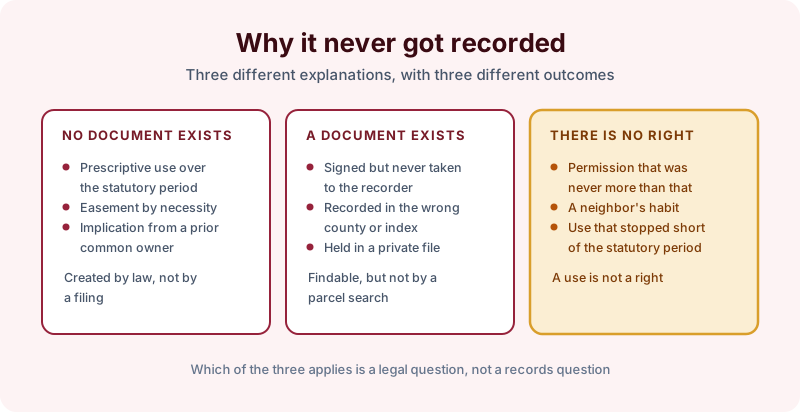
Three explanations cover almost every case, and they lead to very different places.
Some easements are created without any document at all. Prescriptive use over the statutory period, an easement by necessity on a landlocked parcel, and an easement implied from a prior common owner all arise by operation of law, which is why prescriptive easements and the record is a standing caution on this site.
Some have a document that never reached the recorder, or reached the wrong index. Those are findable, just not by a parcel search, and they tend to surface from the parties rather than the county.
And some lines have nothing behind them. A neighbor who has crossed for years with permission has a habit, not a right. So does a use that stopped short of the statutory period.
The label on the survey is worth reading closely before any of this. Surveyors distinguish between an easement they located from a recorded description and an apparent one they observed, and the second kind is a flag rather than a finding. Where the drawing cites a book and page, the instrument exists and the search simply has to reach it. Where it cites nothing, the line is the surveyor’s observation and the question is still open.
How to work the gap
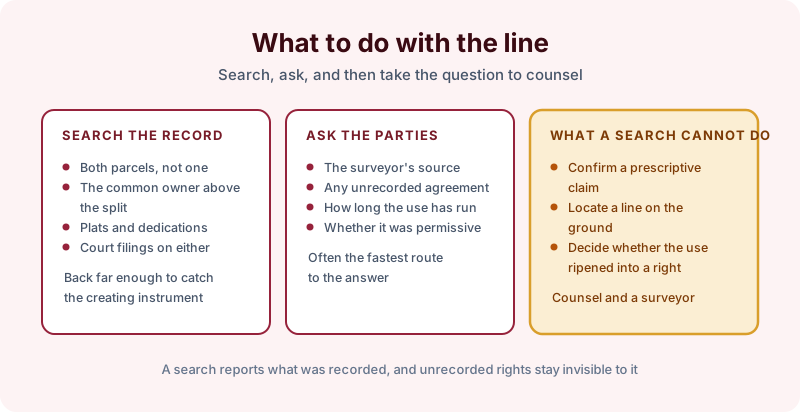
Search both parcels rather than one. Most of these rights were created at a split, so the instrument that made the easement frequently sits in the chain of the common owner above the division, which is why term length matters and why a current owner search is the wrong tool here. Our note on why a recorded easement gets missed covers the indexing reasons a real instrument can hide.
Then ask. The surveyor can usually say what they relied on. The seller can say how long the use has run and whether it was ever permissive. An unrecorded written agreement sitting in somebody’s file is a frequent and quick answer.
Where the line turns out to be a shared driveway, the follow-on questions about maintenance and repair arrive immediately, and shared driveway easements sets out what the record usually does and does not say about who pays for what.
The takeaway
A search of the land records reports what has been recorded and indexed in that county over the term searched, and recording and indexing practice varies from county to county. It can find the instrument behind the line, and it can prove that nothing was recorded. It cannot confirm a prescriptive claim, locate the easement on the ground, or decide whether a long use ripened into a right, and those are questions for counsel and for the surveyor. Our easement search packages run 20, 30 and 50 year terms for that reason, and the work comes back in 2 to 3 business days. Start the order online, or send us the address and the county and we will tell you which term fits and what it would and would not cover before anything is ordered.