

· AFX Research
Rail Trail Conversions and the Old Railroad Right of Way
Whether a corridor was granted in fee or as an easement decides what a conversion to a public trail does to the abutting land, and the deciding instrument is usually very old.
Table of Contents
Thousands of miles of abandoned railroad line have been converted to public trails, and the strips run past a great many ordinary parcels. If a trail borders the property you are buying, selling or lending on, the useful question is not what the trail is now. It is what the railroad was given in the first place, because that is what decides whether the corridor is somebody else’s land or a burden sitting on yours.
Fee or easement, and why it governs everything after
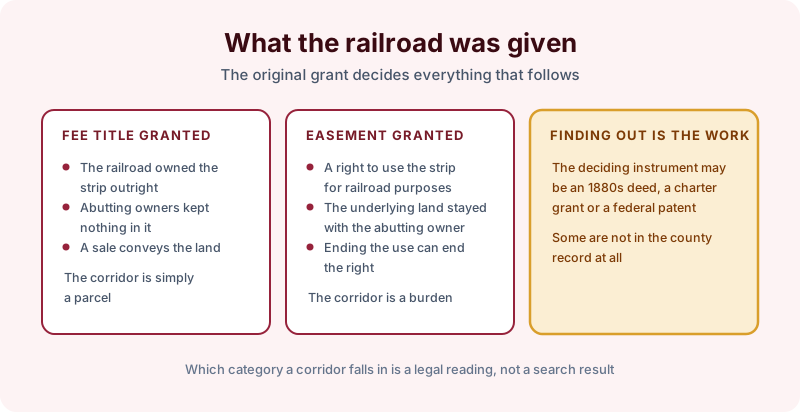
Railroads acquired their corridors in several ways, and the paperwork from the 1860s through the 1920s is not uniform. Some strips were conveyed in fee, meaning the railroad owned the ground outright and the neighbors kept no interest in it. Others were granted as an easement for railroad purposes, leaving the underlying land with the abutting owner, subject to the railroad’s right to use it.
Where the grant was an easement, ending the railroad use can end the right, and the strip is then simply part of the parcel it was carved from. Where the grant was a fee, nothing reverts to anybody. The two outcomes are very different and they are decided by a single old instrument, which may be a deed, a charter grant, a condemnation judgment or a federal land patent of the kind covered in rights reserved in an original land patent.
Locating that instrument is the real work. Our note on railroad right of way easements describes how those corridors read in the record generally.
What a conversion actually leaves at the recorder
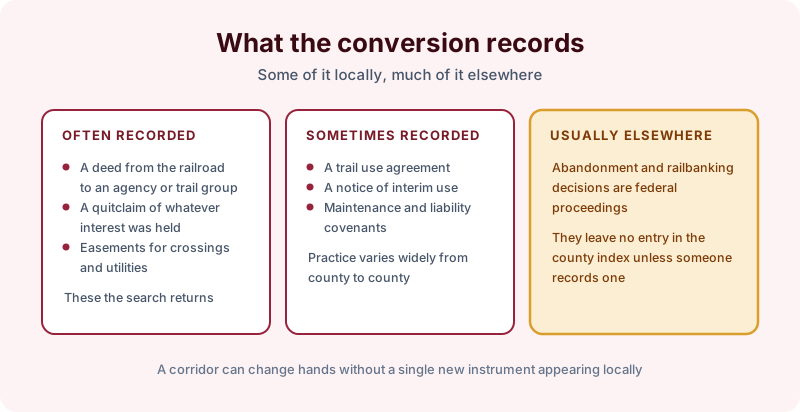
A conversion usually involves a federal proceeding in which the line is formally discontinued and the corridor is preserved for possible future rail use while serving as a trail in the meantime. That proceeding happens in Washington, not at the county, and the agency file is where the operative dates live. Nobody is obliged to mirror it into the local index, and in many counties nobody does.
Locally you may find a deed or a quitclaim from the railroad to a public agency or a trail organization, easements reserved for crossings and utilities, and sometimes a recorded trail use agreement with maintenance and liability terms. Practice varies a great deal, and the honest description is that a corridor can change hands without a single new instrument appearing in the county index.
That gap is why searching the corridor and searching the abutting parcel are two different jobs, and why the term you order matters. A short search reads recent activity. Reaching the original grant is what the longer terms in our easement search packages are for.
What it means for the parcel next door
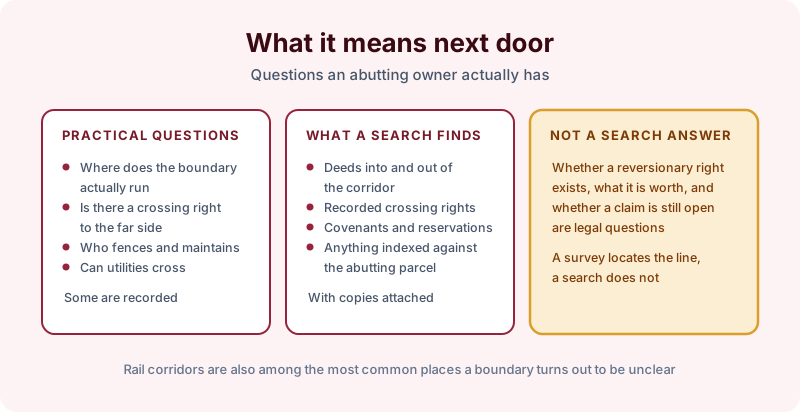
Owners ask practical things. Where does my boundary actually run? May I cross to the other side? Who fences it, and who is responsible when somebody is hurt? Can a utility line cross the corridor to reach me?
Some of those are answered by recorded crossing rights, reservations and covenants, and those come back in a search with copies attached. The rest are not records questions. Whether a reversionary right exists, whether a claim for it is still open, and what any of it is worth are matters for counsel. A search is also not a survey, and rail corridors are one of the more common places where the line on the ground and the line in the description disagree, as encroachment or easement describes.
The takeaway
An easement search reports what was recorded and found in the indexes reviewed over the term searched, in the county where the property sits. Prescriptive crossings and informal use rights are frequently created without any recorded instrument, so a clean report is never proof a corridor is unburdened, and recording practice varies by county. Start the order online, or send us the address and the county and we will tell you which search term fits and what it would and would not cover before anything is ordered.