

· AFX Research
Reciprocal Easement Agreements in Shopping Centers, What to Check
One center, several owners, and a recorded contract that governs all of them. What an REA grants, what it forbids, and why the amendments matter more than the original.
Table of Contents
Somebody buys the former bank pad at the front of a strip center, planning a drive-through coffee shop. The zoning allows it, the site works, and the deal dies six weeks in, because a document recorded in 1987 gives the grocery anchor an approval right over anything built within the parking field, and nobody read it until financing was in process. That document is a reciprocal easement agreement, and on any multi-owner retail property it is the most consequential instrument in the file. It behaves much like the arrangements in easements in a condominium or planned community, scaled up to commercial parcels.
What an REA creates
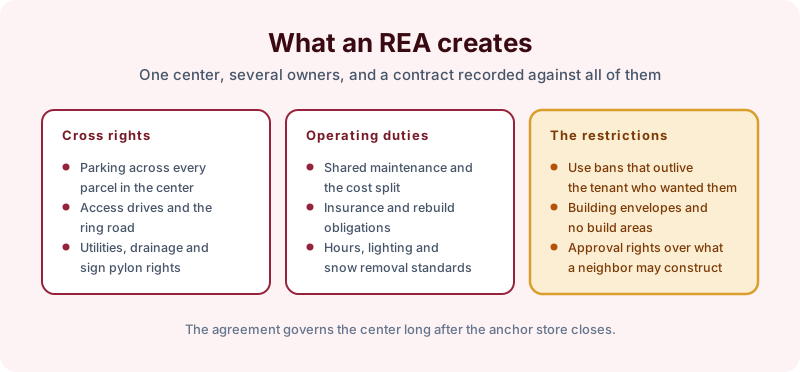
An REA does three jobs at once. It grants cross rights, so that customers can park on one parcel and walk to a store on another, so the ring road works as a single circulation system, and so utilities, drainage and the pylon sign serve the whole center regardless of which parcel they sit on.
It imposes operating duties. Common area maintenance and the formula that splits its cost. Insurance and rebuild obligations. Standards for hours, lighting, striping and snow removal, each enforceable by the other owners.
And it restricts. Use bans negotiated for an anchor tenant are written into the agreement and outlive that tenant by decades — a prohibition on a second pharmacy survives the pharmacy that asked for it. Building envelopes and no-build areas fix where anything can go, which is the commercial cousin of building near an easement. Approval rights let one owner veto another’s plans.
Finding it in the record
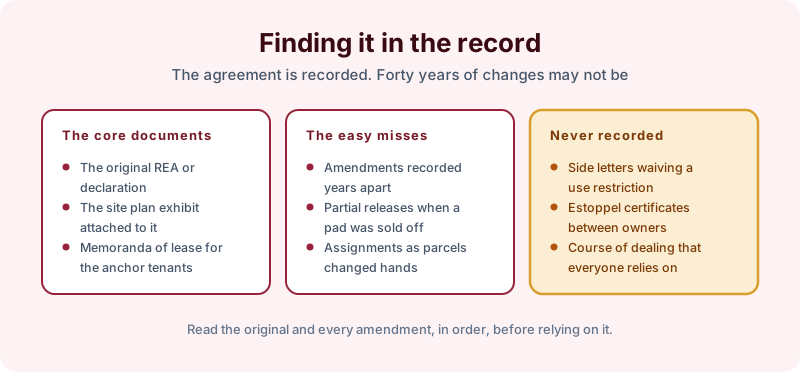
The original is recorded and a search will find it, usually with a site plan exhibit attached, often alongside memoranda of lease for the anchors.
The amendments are where searches go wrong. A center that opened in 1987 may have been amended in 1994, 2003, 2011 and 2019, each time under a slightly different set of owner names, and each amendment recorded separately. Pad sales generate partial releases. Parcel transfers generate assignments. Reading the original without the chain of amendments produces a confident and wrong answer.
Some of it is never recorded at all. Side letters waiving a use restriction for one tenant, estoppel certificates exchanged at a prior closing, and the ordinary course of dealing that every owner in the center relies on and none of them filed. A records search reports what was recorded and indexed, so a clean report on the amendments is not proof that no side agreement exists.
Why the search has to cover every parcel
An REA binds a defined group of parcels, and the instrument may be indexed against some of them and not others, particularly after pads were split off. Searching only the parcel being bought can miss an amendment recorded against the anchor tract. Where the center name appears in the indexing, it is frequently the most reliable hook — more reliable than an owner name that has changed four times.
Recording and indexing practice varies by county, so this is not a universal rule so much as a reason to give the abstractor the whole center rather than one parcel of it.
Scoping the search
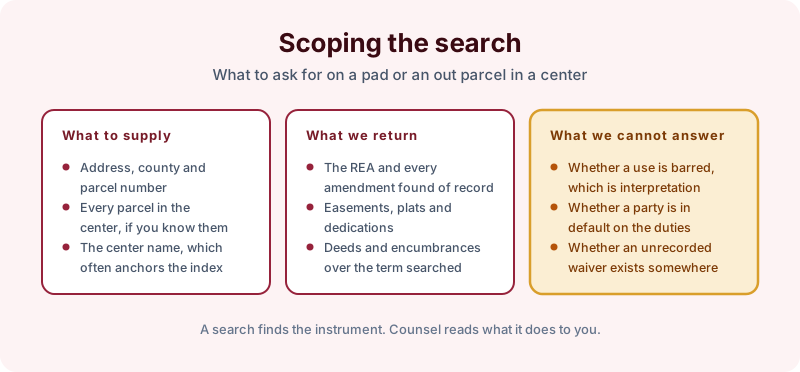
Give us the address, county and parcel number, the other parcels in the center if you can identify them, and the center’s name. What comes back is the REA and every amendment found of record, the easements, plats and dedications, and the deeds and encumbrances over the term searched. Our process page sets out how that work is done.
What we cannot answer is whether your intended use is barred, whether any party is currently in default on its obligations, or whether an unrecorded waiver is sitting in somebody’s file. The first is interpretation and belongs to counsel; the others are outside the record.
The takeaway
On a multi-owner retail property the REA decides more than the zoning does, and the amendments decide more than the original. Order the search early enough that counsel can read the full stack before the deal depends on it. Start the order online, or send us the address and the county and we will tell you which term fits and what it would and would not cover before anything is ordered.