

· AFX Research
Easements in a Condominium or Planned Community: What to Check
Declarations, plats, utility strips, and cross access deals with the neighbors. Four separate layers of recorded rights over the same ground, and how to search them.
Table of Contents
Buyers in a condominium or a planned community tend to assume the easement question is somebody else’s problem — the association’s. It mostly is, right up until the driveway to your building turns out to run over a strip the developer never dedicated, or a fiber crew arrives to trench across the courtyard under a grant recorded in 1974. These parcels carry more layers of recorded rights than a standalone lot, not fewer, and they are indexed in different places. Our note on easements created by a subdivision plat covers one of those layers; this is the whole stack.
Four layers over the same ground
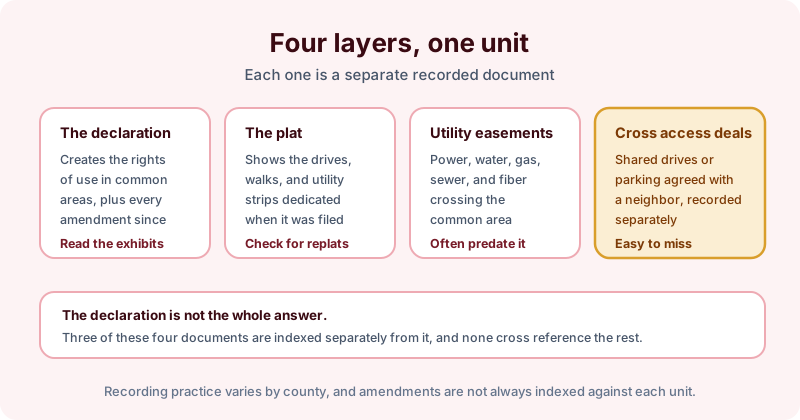
The declaration is the founding document. It creates the unit owners’ rights of use in common areas, and it usually carries exhibits describing them. It also gets amended, sometimes many times over forty years, and the amendments are separate recorded instruments.
The plat shows what was dedicated when the community was created: drives, walks, utility strips, drainage. Replats and corrections happen, and each one is its own filing.
Utility easements are frequently older than the community itself. A power line easement granted across a farm in 1961 does not disappear because a condominium was built on the farm in 1998.
Cross access agreements are the layer people miss entirely. Shared driveways, shared parking, or reciprocal access negotiated with the commercial parcel next door are recorded on their own, referenced nowhere in the declaration, and easy to overlook because nobody thinks to look for them.
Who controls the common area
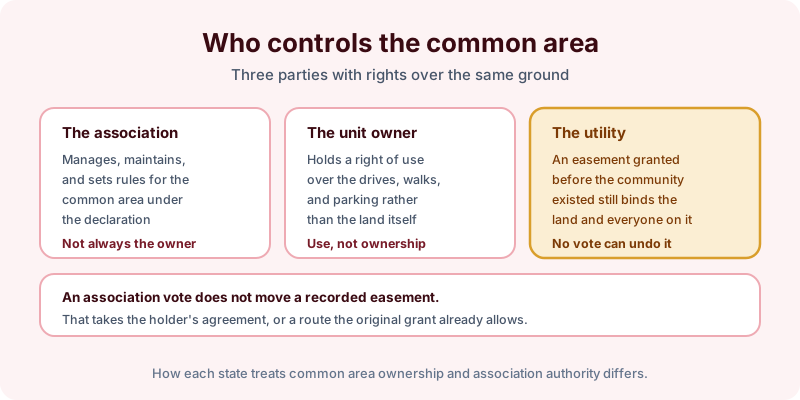
Three parties hold rights over the same ground, and their positions differ. The association manages and maintains, and depending on how the community was structured it may or may not own the land. The unit owner typically holds a right of use over the drives, walks, and parking rather than owning that ground. A utility holds whatever its recorded grant gives it.
The practical consequence is worth stating plainly: an association vote does not move a recorded easement. Relocating one takes the holder’s agreement or a route the original grant already permits, which is the subject of our note on relocating or amending an easement. How each state treats common area ownership and association authority differs, and those are questions for counsel rather than for the abstractor.
Where the trouble usually starts
Two patterns account for most of the disputes. The first is a phased development that was never finished. Phase three was platted, easements were dedicated across it for the benefit of phases one and two, and then the developer sold the raw ground to somebody else. The access is recorded, the new owner did not read it, and both sides are surprised.
The second is a boundary between the community and a single commercial neighbor. A restaurant, a bank branch, or a strip center adjoining a planned community almost always has some arrangement about the shared curb cut, and it is usually thirty years old. Whether it was ever recorded is the question, and it is answerable from the record in a way that the parking argument in the driveway is not. Our note on shared driveway easements covers the same problem on a residential scale.
Scoping the search
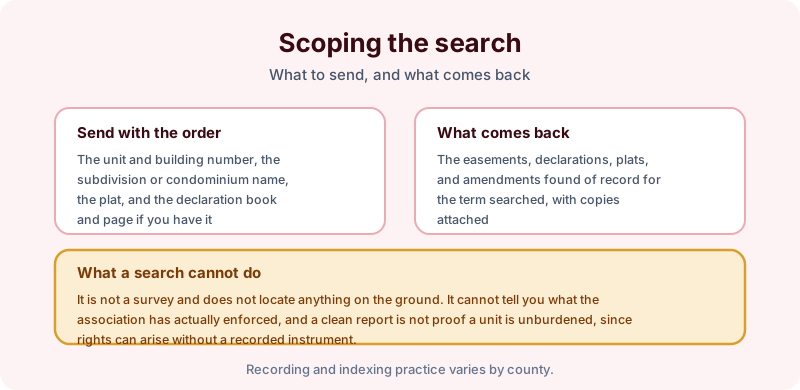
Send the unit and building number, the community name, the plat, and the declaration book and page if you have it. Depth matters here more than on an ordinary lot, because the useful documents are the old ones: pick a search term that reaches back past the development to the parcel it was built on. Turnaround is 2 to 3 business days.
What comes back is the easements, declarations, plats, and amendments found of record over the term searched, with copies attached. What does not come back is where anything sits on the ground, which is survey work, or what the association has actually been enforcing. Recording and indexing practice varies by county, amendments are not always indexed against each unit, and a clean report is not proof a unit is unburdened, since rights can arise without any recorded instrument.
The takeaway
Treat the declaration as one document among four rather than as the answer, and read the utility grants that predate the community. Start the order online, or send us the address and the county and we will tell you which search term fits and what it would and would not cover before anything is ordered.