

· AFX Research
Shared Dock and Pier Easements, and Who Actually Holds Them
A right to reach the water, a right to moor at it, and a permit to have a structure there are three separate things. What the record settles, and what it does not.
Table of Contents
A buyer tours a lake house, sees a dock with four slips, and is told one of them comes with the property. Sometimes that is exactly right and recorded. Sometimes the slip belongs to an association, or to the neighbor personally, or to nobody in a way that survives a sale. The arrangement is usually three separate rights stacked together, and a search has a clear view of one of them. It is a more layered version of waterfront and lake access easements.
Three layers of ground
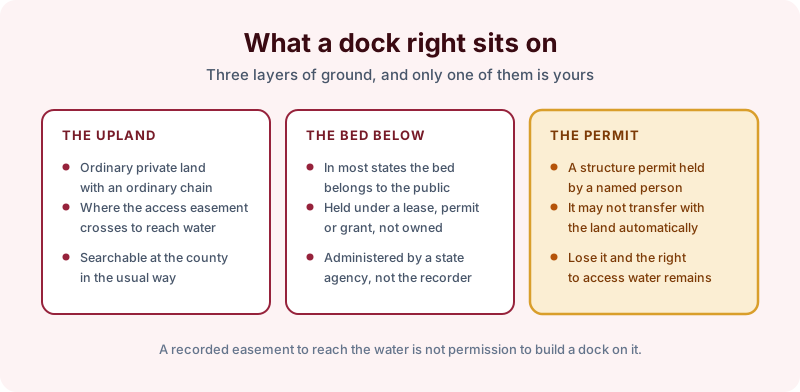
The upland is ordinary private land with an ordinary chain, and it is where an access easement crosses to reach the shore. A county search handles it.
The bed below the water usually is not private at all. In most states the land under navigable water belongs to the public, held in trust, and whatever sits on it does so under a lease, permit, or grant from a state agency rather than by ownership. That is not a county record, and a search of the land records will find nothing about it however carefully it is run. Rivers and tidal water are the clearest cases; private ponds and some man made lakes work differently again.
And the structure itself needs permission. Docks and piers are permitted, often by more than one authority, and a permit is frequently issued to a named person rather than attached to the parcel. The consequence catches people out — a recorded easement to reach the water is not permission to build or keep a dock on it, and the two can be held by different people.
Who actually holds the right
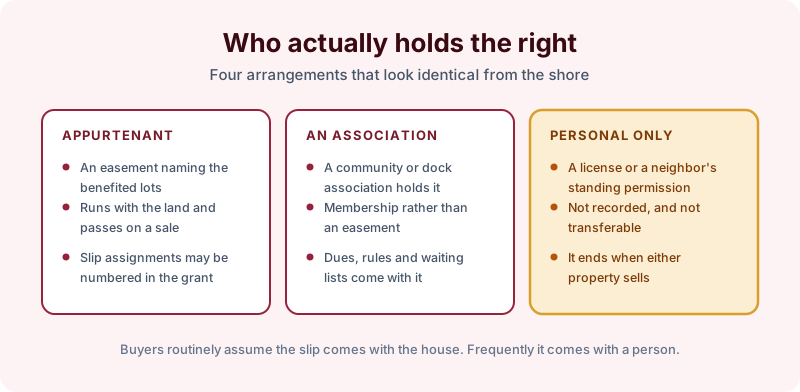
An easement appurtenant is the strongest version. It names the benefited lots, runs with the land, and passes automatically on a sale, sometimes with slip numbers assigned in the grant itself. That is the arrangement a buyer hopes for, and the distinction between it and the alternative is set out in easement appurtenant versus easement in gross.
An association holding is next. A community or dock association owns or controls the structure and allocates slips to members, which means what a buyer gets is membership with dues, rules, and possibly a waiting list. The declaration creating the association is recorded and worth reading in full, because it will say whether slips follow lots or are reassigned.
A personal arrangement is the weakest and the most common source of disappointment. A license, or simply a neighbor’s standing permission, unrecorded and not transferable, which ends the moment either property changes hands.
What to check before closing
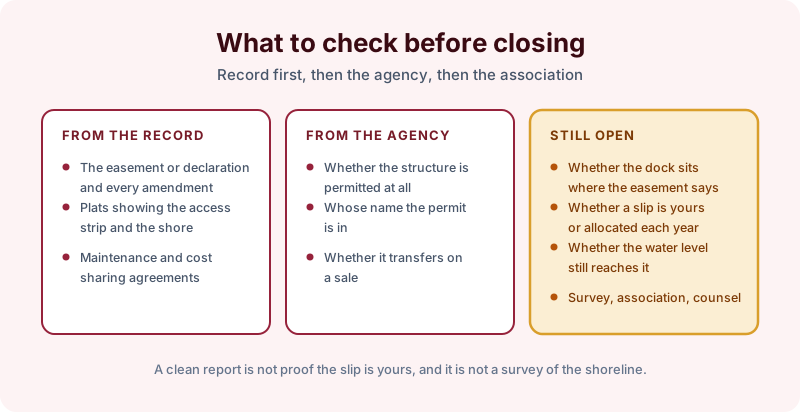
From the record, pull the easement or declaration with every amendment, the plats showing the access strip and the shoreline, and any maintenance or cost sharing agreement. Those last ones matter, because a dock is a wasting asset sitting in water, and somebody has to pay to rebuild it. An agreement that is silent on cost sharing tends to become an argument about ten or fifteen years in.
From the agency, establish whether the structure is permitted, whose name the permit is in, and whether it transfers on a sale.
What remains open is not records work. Whether the dock as built sits where the easement says, whether a slip is permanently yours or allocated annually, and whether the water still reaches it are questions for a survey, the association, and counsel. A search reports what was recorded and found over the term searched, it is not a survey, and a clean report is never proof that a parcel carries the rights a seller describes. Our terms run 20, 30, and 50 years, our search packages set out what each reaches, and most searches come back in 2–3 business days.
The takeaway
Separate the three rights before you pay for the view. Get the recorded easement or declaration, confirm the permit and whose name it carries, and find out whether a slip is a property right or a membership. Start the order online, or send us the address and the county and we will tell you which search term fits and what it would and would not cover before anything is ordered.