

· AFX Research
What a Quitclaim Deed Does to an Easement in the County Record
How a quitclaim can grant an easement, release one, or leave it entirely untouched, and the four lines in the deed that decide which of the three happened.
Table of Contents
Quitclaim deeds have a bad reputation they only half deserve. People read one in a chain and assume something went wrong, when most of them are routine transfers between relatives or cheap ways to clear up a doubtful claim. Where they genuinely matter to an easement search is that the same one-page form can create a right, end one, or do neither, and the only way to tell is to read it. That is a different exercise from the one in our note on easements reserved in a deed versus granted separately.
What a quitclaim conveys
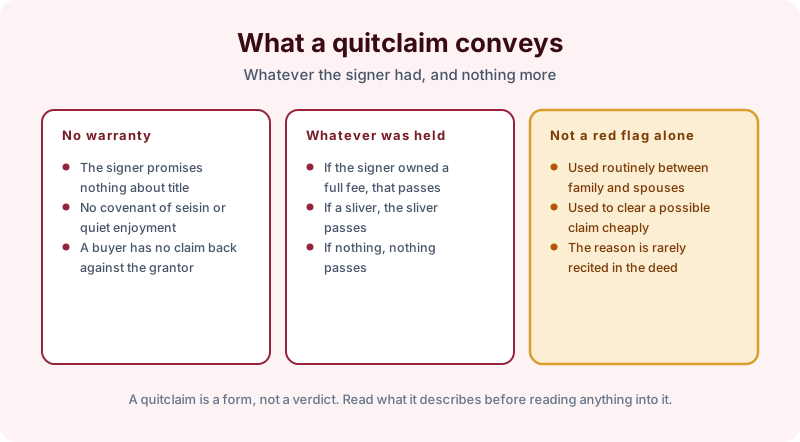
Nothing is promised. A warranty deed carries covenants that the signer owns what is being conveyed and will defend it; a quitclaim carries none, so a buyer who later discovers the grantor owned nothing has no claim back against them.
What passes is whatever the signer actually held at that moment. A full fee, a fractional interest, an easement right, or nothing at all. The deed is a pipe, and the water in it is whatever the grantor had.
That is why a quitclaim in a chain is not by itself a defect. It is the usual instrument for a transfer between spouses, for an heir releasing a possible interest, and for a neighbor clearing up a boundary. The reason is rarely recited, so a searcher reports the instrument and resists narrating a motive.
Three ways it touches an easement
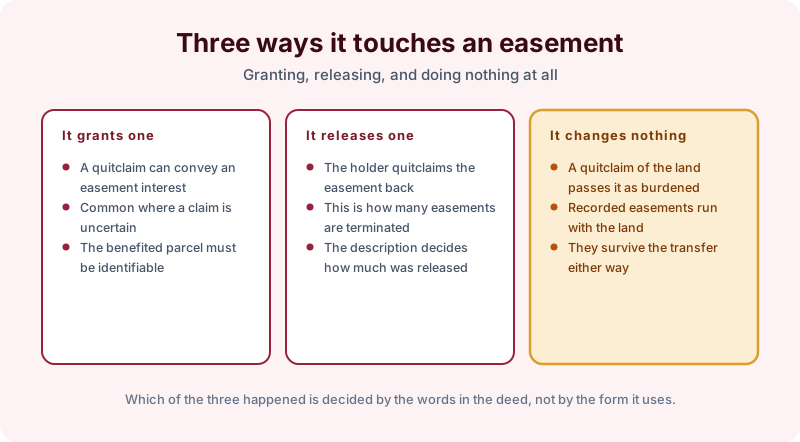
First, it can grant one. A quitclaim is a common way to convey an access right where the grantor is not certain what they hold, and it works if the benefited parcel is identifiable.
Second, it can release one. This is how a great many easements are actually terminated. The holder quitclaims the right back to the burdened owner, and the description in that release decides whether all of the easement went or only part.
Third, and most often, it does nothing to the easement at all. A quitclaim of the land passes the land as it stands, burdened. Recorded easements run with the land and survive a transfer regardless of the deed form used.
Reading a quitclaim in the chain
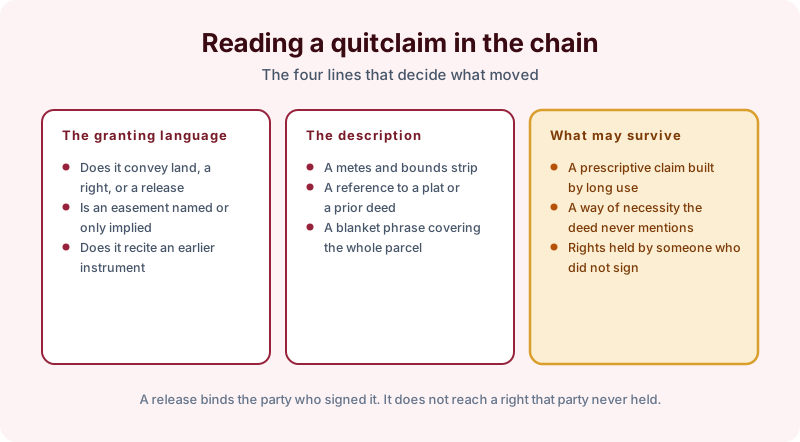
We read the granting language first. Does it convey land, a right, or a release, is an easement named or merely implied, and does it recite an earlier instrument we should pull. Then the description, which may be a metes and bounds strip, a reference to a plat or a prior deed, or a blanket phrase covering the whole parcel. Those two lines usually settle what moved.
What a release does not reach is a right the signer never held. A prescriptive claim built by long use, a way of necessity the deed never mentions, or an interest belonging to someone who did not sign can all survive a release that looks comprehensive. Easements of that kind are frequently created with no recorded instrument at all, so a clean report is never proof that a parcel is unburdened, and a search is not a survey and does not locate anything on the ground. Recording practice varies by county, and the legal effect of a particular release is a conclusion for counsel.
Where quitclaims cluster in a chain
Two places, and both are worth slowing down for. The first is a cleanup run before a sale, where a seller gathers quitclaims from a former spouse, an estranged heir or an adjoining owner. Those deeds often carry no description beyond the parcel number, and whether they released an access right along with the land is a genuine question.
The second is the end of a utility or railroad corridor. When a line is abandoned, the holder frequently quitclaims the corridor rather than issuing a formal release, and the adjoining owners receive a deed whose description follows the old centerline. Whether the underlying fee came with it, or only the easement went away, turns on what the original grant conveyed decades earlier. The pattern in our note on rail trail conversions is the same question in another costume.
The takeaway
Treat a quitclaim as a document to read rather than a signal to react to, and pay attention to the description, since that is where the scope of a grant or a release is actually set. The types of easements page sets out the categories, and the search packages set out which term reaches back far enough, and our search terms run 2–3 business days. Start the order online, or send us the address and the county and we will tell you which search term fits and what it would and would not cover before anything is ordered.