

· AFX Research
When a Utility Occupies by Franchise and Not by Easement
Why a power, water or telecom line can sit lawfully on land with nothing recorded against the parcel, where that authority is written down, and how to ask for it.
Table of Contents
A buyer sends over a photograph of poles crossing the back of a lot and asks what the easement says. Sometimes the honest answer is that there is no easement, and the line is there lawfully anyway. Utilities have more than one way to occupy ground, and only one of them produces an instrument indexed against the parcel. That gap is a cousin of the problem in our note on why a recorded easement gets missed, except here nothing was missed because nothing was filed.
How a utility gets the right
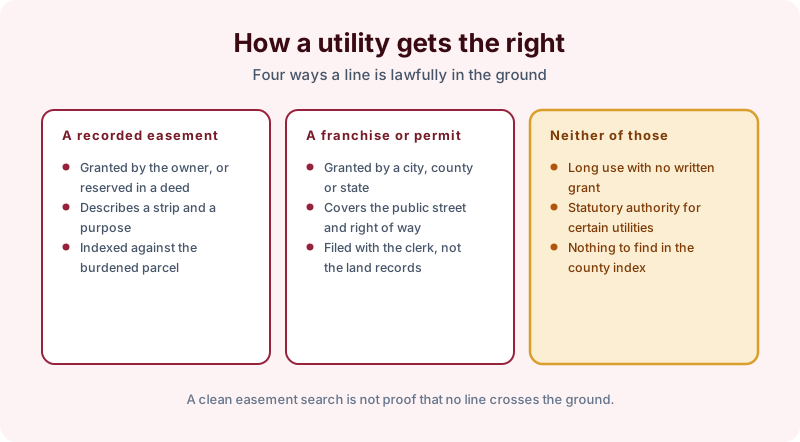
The clean case is a recorded easement, granted by the owner or reserved in a deed, describing a strip and a purpose and indexed against the burdened land. That is what a search is built to find.
The second case is a franchise or a permit. A city, county or state grants a utility the right to place facilities in the public streets and rights of way, usually by ordinance, and the utility then pulls encroachment permits for particular work. If the poles follow the street, the authority may be entirely municipal and entirely absent from the land records.
The third case is neither. Long use without a written grant can ripen into a prescriptive right in many states, and some utilities hold statutory authority to occupy particular corridors. Both can leave a county index with nothing to report.
Where a franchise is written down
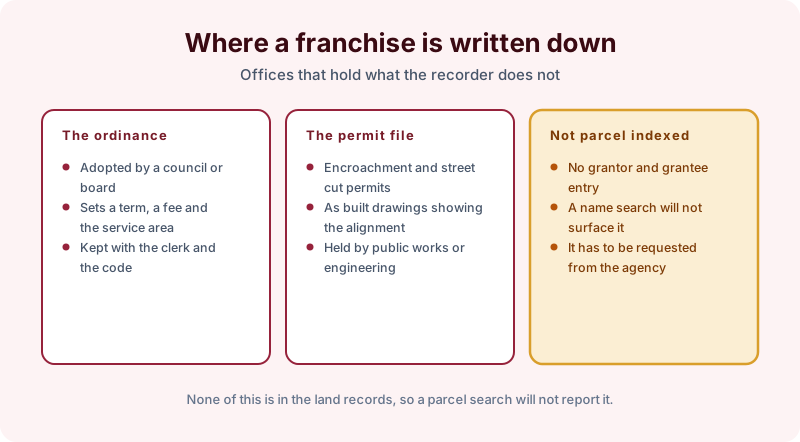
The franchise itself is an ordinance adopted by a council or board, setting a term, a fee and a service area, and kept with the clerk and in the municipal code. It names a utility and a jurisdiction, not a parcel.
The location of the line lives somewhere else again, in encroachment and street cut permits and in as built drawings held by public works or engineering. Those are the records that answer where, and they are frequently the only records that do.
None of it is parcel indexed. There is no grantor and grantee entry, a name search will not surface it, and no abstractor working the land records can produce it. It has to be requested from the agency, usually by address or by intersection rather than by legal description.
Why the distinction changes what you can do
An easement is property. A franchise is permission. That difference decides nearly every practical question an owner asks.
If the line sits under a recorded easement, the strip and the purpose are fixed by the instrument, and widening the use or adding a second carrier usually requires a new grant. The burdened owner has something to negotiate with, and our note on overburdening an easement covers what happens when the use outgrows the grant.
If the line sits in the public right of way under a franchise, the owner is frequently not a party to anything. The fee under a street is often held by the adjoining owners subject to the public’s right, and the utility is there because the municipality said so. Moving the line is then a question for the agency and the franchise terms, not a private negotiation, and the cost of relocation is usually assigned by the franchise rather than by the deed.
The practical consequence for a buyer is that a quiet index does not mean a quiet parcel, and that the absence of a recorded easement is sometimes good news and sometimes the opposite.
Searching a parcel with a line on it
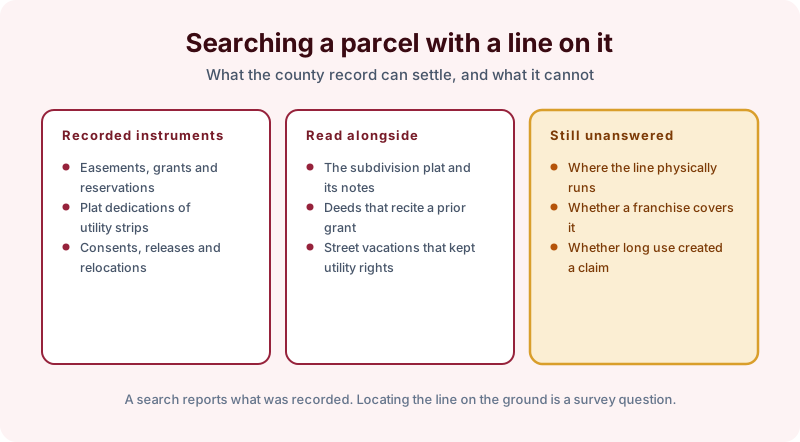
We report the recorded instruments, meaning easements, grants and reservations, plat dedications of utility strips, and any consents, releases or relocations found of record. Read alongside those we look at the subdivision plat and its notes, deeds that recite a prior grant, and street vacations, which very often reserve utility rights even while giving up the roadway.
What stays unanswered is where the line physically runs, whether a franchise covers it, and whether long use has created a claim nobody wrote down. A clean report is not proof that a parcel is unburdened, and a search is not a survey. Recording and indexing practice varies by county, and whether a particular occupation is lawful is a conclusion for counsel.
The takeaway
When a line appears on the ground and nothing appears in the index, the next call is to the city or county rather than back to the recorder. Order the records search to establish what was granted and dedicated, then ask public works for the permit file. Our search packages run 2–3 business days. Start the order online, or send us the address and the county and we will tell you which search term fits and what it would and would not cover before anything is ordered.