

· AFX Research
Easements and Covenants When a Homeowners Association Dissolves
The entity can lapse without the recorded easements and covenants going anywhere, which leaves a private road, a detention pond and a set of rules with nobody obviously in charge.
Table of Contents
Small associations lapse constantly. A volunteer board stops filing the annual report, the registered agent resigns, and a few years later the state has the entity marked inactive and nobody in the subdivision has noticed. Then somebody tries to sell a lot, and the questions start. The useful thing to know is that the entity and the recorded instruments are two different things, and only one of them ended.
What dissolution does not touch
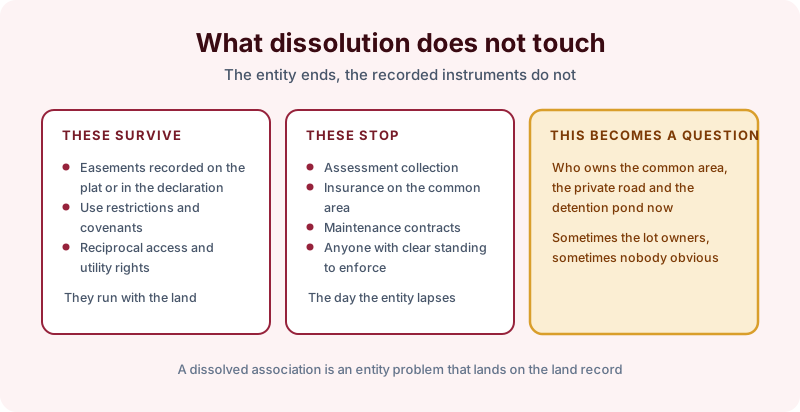
Easements and covenants recorded on the plat or in the declaration run with the land. They were created by recorded instruments against the lots, and the dissolution of a corporation does not remove them. Access rights, utility rights, setback and use restrictions and architectural controls all remain written against every parcel in the subdivision.
What stops is the association’s activity. Assessment collection ends, insurance on the common area lapses, maintenance contracts fall away, and the question of who has standing to enforce anything becomes genuinely unclear.
The open question is ownership of the common area. A private road, a detention pond, a clubhouse or an entrance strip that was deeded to the association now belongs to an entity that no longer exists in a legal sense, and working out who owns it today is a conveyancing problem with no single answer.
Two ways one ends
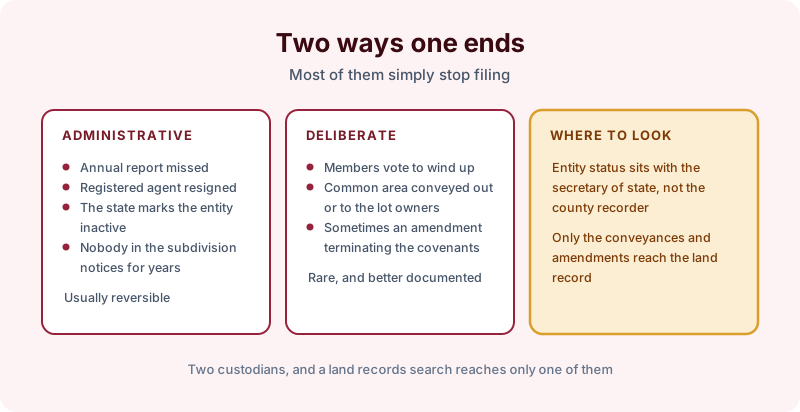
Most dissolutions are administrative. A filing was missed, the state marked the entity inactive, and in most states it can be reinstated by catching up on the paperwork. Nothing was decided and nothing was conveyed.
A deliberate wind up is rarer and better documented. Members voted, the common area was conveyed somewhere, and occasionally an amendment terminating the covenants was recorded.
The two are found in different places, which is the part that trips people up. Entity status sits with the secretary of state. Only the conveyances and the recorded amendments reach the county, so a land records search tells you what happened to the land and not what happened to the corporation. Both are worth having.
Buying a lot where this has happened
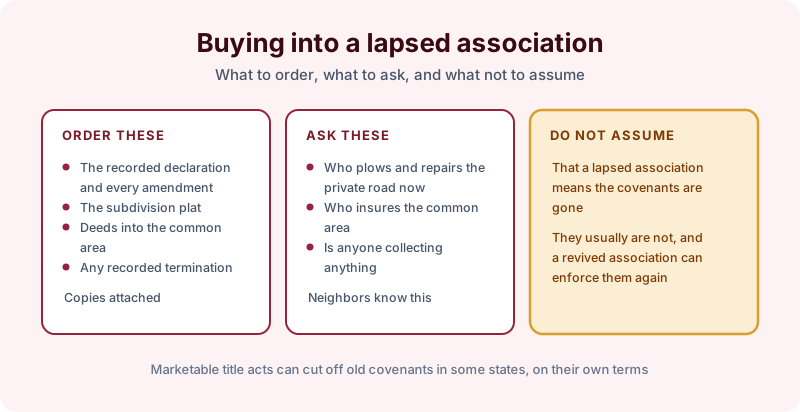
Order the recorded declaration and every amendment, the subdivision plat, the deeds into the common area and any recorded termination. Those are the documents that define what the lot carries, and they come back with copies.
Then ask the practical questions, because neighbors know the answers and no record does. Who plows and repairs the private road now? Who insures the clubhouse? Is anybody collecting anything, and under what authority? A road maintained by informal agreement for fifteen years is a different proposition from one nobody has touched, and the recorded arrangements for that are covered in private road maintenance agreements.
The thing not to assume is that a lapsed association means the covenants are gone. Usually they are not, a reinstated association can enforce them again, and a buyer who built something on that assumption is exposed. Some states do cut off old covenants through a marketable title act, on their own terms and with their own preservation requirements, which is the subject of easements and marketable title acts.
Where the common area ends up
This is the question most likely to need a lawyer. Depending on the state and on what the declaration says, a common area may pass to the lot owners as tenants in common, may remain with a dormant entity pending reinstatement, or may be subject to a reverter back to the original developer. Our note on easements in a condominium or planned community sets out how those interests are structured in the first place.
Whatever the answer, the easements over that land in favor of the lots are usually the strongest thing a buyer has, which is a good argument for reading the plat carefully.
The takeaway
An easement search reports what was recorded and found in the indexes reviewed over the term searched, in the county where the property sits. It does not report corporate status, which is held by the state, and it cannot tell you whether a covenant remains enforceable or who owns the common area today. Those are conclusions for counsel. Start the order online, or send us the address and the county and we will tell you which search term fits and what it would and would not cover before anything is ordered.