

· AFX Research
Quiet Title Actions and How They Reach an Easement Claim
What a quiet title suit decides about a disputed right of way, which documents it leaves at the recorder, and why a recorded decree does not bind everybody.
Table of Contents
When the land records cannot settle whether a right of way exists, somebody eventually asks a court. A quiet title action is the usual vehicle, and it turns an argument about an ambiguous old instrument into a recorded document with a clear answer in it. If you are buying, selling or lending on a parcel whose chain contains one, it pays to understand what the decree settled and, more importantly, who it settled it against.
Why the suit gets filed
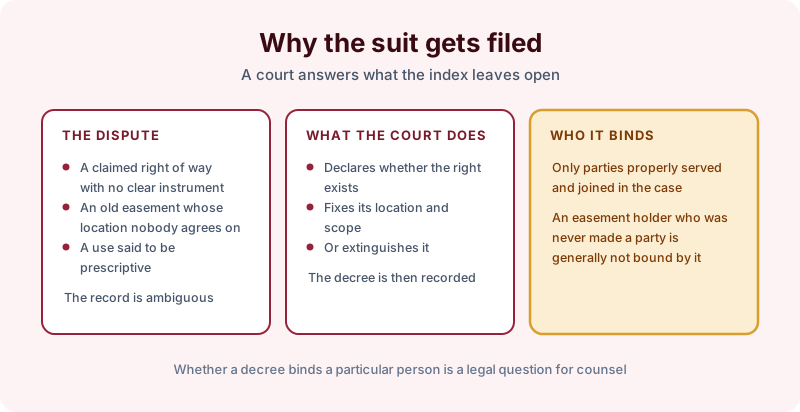
Easement disputes reach court for a few recurring reasons. A neighbor claims a right of way that no instrument clearly grants. An old easement is plainly recorded but its location was never described well enough to find on the ground, the problem covered in an easement with a defective legal description. Or a use has gone on long enough that somebody claims it has ripened into a right, which is the situation described in prescriptive easements and the record.
The court declares whether the right exists, fixes its scope and location, or extinguishes it. That ruling is then recorded, and from that point it is part of the chain, in the same way as the orders described in easements created by a court order or partition.
What the case leaves at the recorder
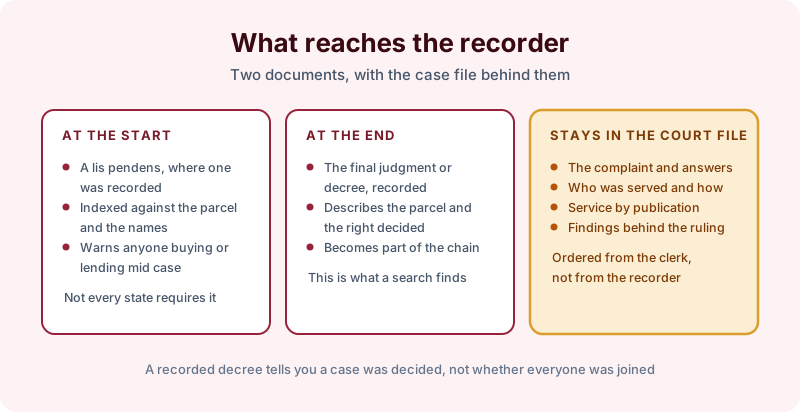
Two documents usually make it into the land records. At the start, a lis pendens may be recorded to warn anyone buying or lending while the case is pending. At the end, the final judgment or decree is recorded, describing the parcel and the right decided.
Everything else stays in the court file. The complaint, the answers, who was served and by what method, and the findings behind the ruling are held by the clerk of court, in a separate system from the recorder. A search of the land records returns the decree and tells you a case was decided. It does not tell you how the case was conducted.
Who the decree actually binds
This is the point that matters most and it is the easiest to skip. A judgment generally binds the people who were properly made parties to it. An easement holder who was never served, or whose interest the plaintiff did not identify, is ordinarily not bound by a ruling that extinguished the right.
Service by publication deserves particular attention. Where a defendant could not be located and notice was given through a newspaper, the adequacy of that service is occasionally challenged years later. None of that appears on the face of the recorded decree.
There is a practical consequence for a buyer. A decree that extinguished a neighbor’s claimed right of way is reassuring, and it is reassuring about the people it names. If the parcel has since been divided, or if the benefited land has changed hands, the people with an interest today may not be the people the court dealt with, a point our note on when the benefited land is divided takes up.
Reading one in a chain
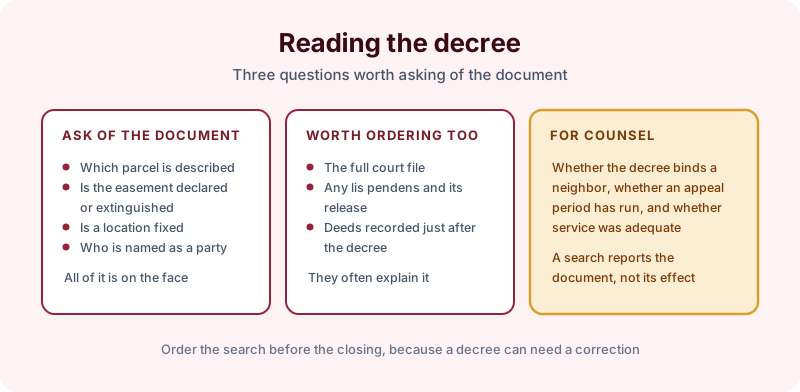
Ask the document which parcel it describes, whether the easement was declared or extinguished, whether a location was fixed, and who was named. Then order the court file alongside it, together with any lis pendens and its release and any deeds recorded shortly afterwards, which frequently exist to tidy up what the decree established.
Whether the decree binds a particular neighbor, whether an appeal period has run, and whether service was adequate are conclusions for counsel in that state. We report the documents found of record and attach copies.
The takeaway
An easement search reports what was recorded and found in the indexes reviewed over the term searched, in the county where the property sits. Easements by necessity and by prescription are often created with nothing recorded at all, so a clean report is never proof a parcel is unburdened, and recording practice varies by county. Start the order online, or send us the address and the county and we will tell you which search term fits and what it would and would not cover before anything is ordered.