

· AFX Research
Recording Acts and Whether an Unrecorded Easement Binds a Buyer
The three kinds of state recording act, how notice from the record or from the ground can bind a buyer anyway, and what an easement search can settle.
Table of Contents
Two documents claim the same strip of land. One was signed in 1994 and never filed. The other is a deed recorded in 2003 to a buyer who says they never heard of it. Which one controls is not decided by the county recorder, and it is not decided by the order the documents were written. It is decided by the recording act of the state the land sits in, and the answer differs depending on which of three rules that state chose. The same statute sits underneath why a recorded easement gets missed and underneath most disputes about priority.
Three rules, one per state
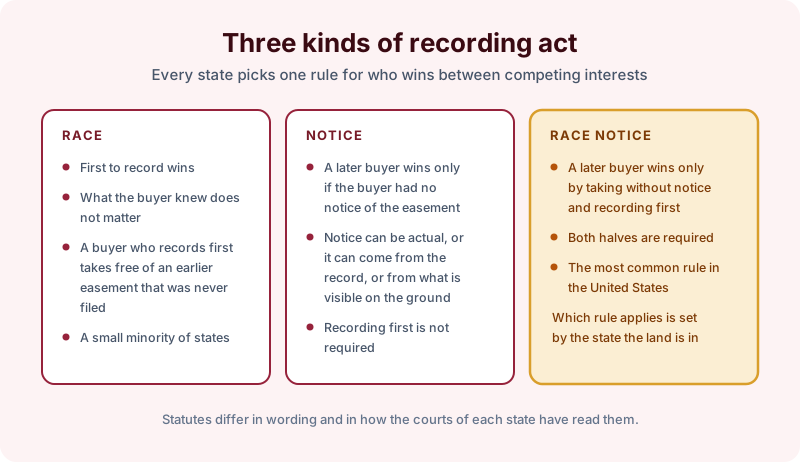
Race. First to record wins, and what the buyer knew is beside the point. A buyer who records first takes free of an earlier easement that was never filed, even one the buyer had heard about. Only a small minority of states use this rule.
Notice. A later buyer wins only if that buyer took without notice of the easement. Recording first is not required. If the buyer knew, or should have known, the easement holds.
Race notice. A later buyer wins only by doing both, taking without notice and recording first. This is the most common rule in the country.
Which rule applies follows the land, not the parties. A buyer in one state and a buyer across the river can get opposite answers on identical facts.
Notice does not only come from the index
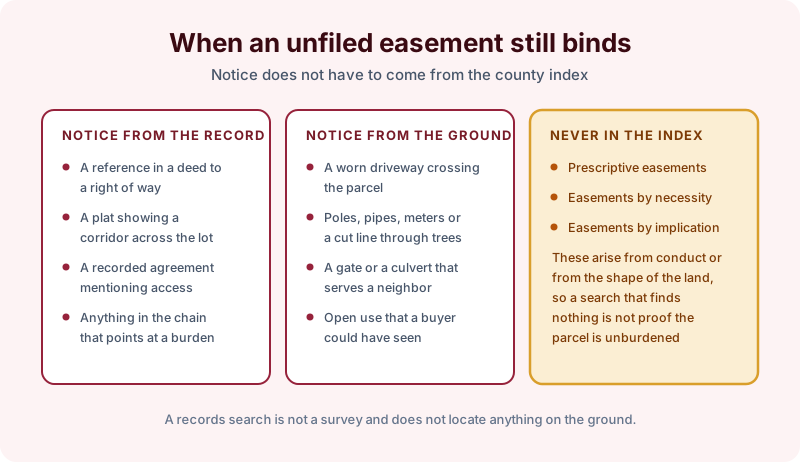
This is the part that surprises people. Under a notice or race notice statute, a buyer can be charged with notice from the chain of title itself, where a deed refers to a right of way, a plat shows a corridor, or a recorded agreement mentions access without ever granting it. The grant may be missing while the pointer to it is right there in the record.
Notice can also come from the ground. A worn driveway crossing the parcel, utility poles and a cut line through the trees, a culvert that plainly serves the neighbor. Open and visible use is the classic example of something a buyer could have seen and is expected to have asked about.
And some easements never appear in any index at all. Prescriptive easements, easements by necessity and easements by implication arise from conduct or from the shape of the land rather than from a signed document, as the posts on prescriptive easements and easements by necessity set out. A search that comes back clean is not proof the parcel is unburdened, and a records search is not a survey, so it never locates anything on the ground.
What the search actually settles
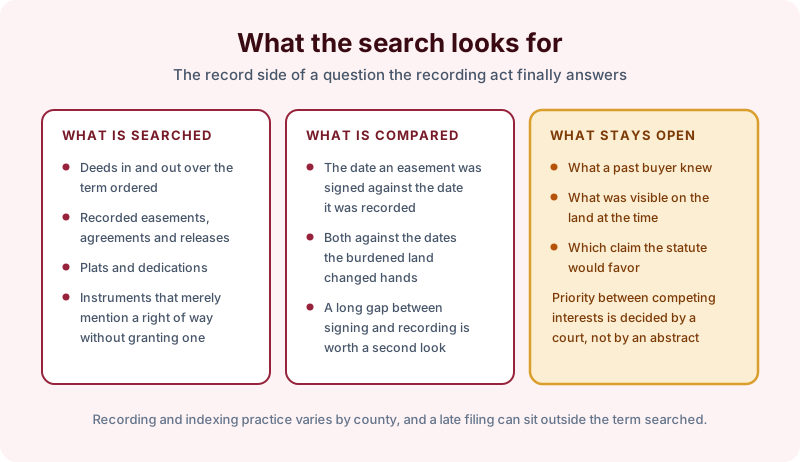
We search deeds in and out over the term ordered, recorded easements, agreements and releases, plats and dedications, and the instruments that merely mention a right of way without creating one. Then the dates get compared, the date an easement was signed against the date it was recorded, and both against the dates the burdened land changed hands. A long gap between signing and recording is exactly the pattern a recording act is written to resolve, so it gets a second look.
What stays open is everything outside the paper. What a past buyer knew, what was visible on the land at the time, and which claim the statute would favor are questions for a court and for counsel, not for an abstract. Recording and indexing practice varies county by county, and a document filed late can sit outside the term ordered entirely, which is one reason the search term you order matters.
The takeaway
A recording act decides who wins when two claims collide, and in most states it rewards the buyer who both lacked notice and recorded first. The search gives you the record half of that question, carefully dated, and tells you plainly where the record runs out. Start the order online, or send us the address and the county and we will tell you which search term fits and what it would and would not cover before anything is ordered.