

· AFX Research
What a Lot Line Adjustment Does to an Easement on the Parcel
Moving a boundary between two parcels rewrites both legal descriptions, and the easements stay exactly where the recorded instruments put them. Where that leaves a buyer.
Table of Contents
A lot line adjustment is one of the quieter transactions in the land records. Two neighbors agree to move the boundary between them, the jurisdiction signs off, a pair of deeds gets recorded, and no new lot is created. It is cheap, it is common, and it has a way of leaving an easement in a place nobody expected.
What the move actually does
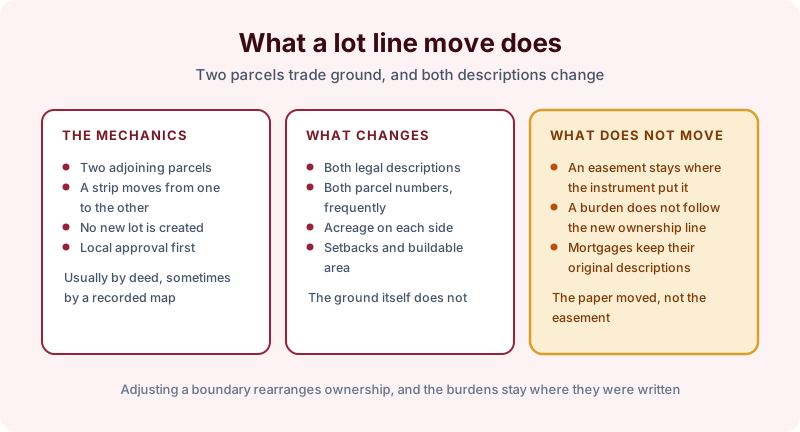
Mechanically, a strip of ground moves from one parcel to the other. Both legal descriptions are rewritten, both assessor parcel numbers frequently change, and the acreage on each side shifts. In most places the adjustment is accomplished by deeds between the two owners after a local approval, and in some it is accomplished by a recorded map instead.
What does not change is the ground, and what does not move is any easement across it. An easement sits where its instrument describes it. It was never attached to a parcel number, and it does not follow a new ownership line.
Where the easement lands afterward
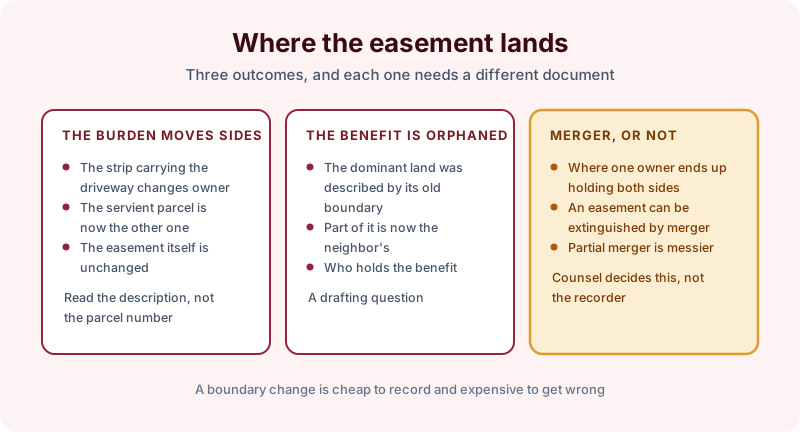
Three things happen often enough to be worth naming.
The burden switches parcels. The strip carrying a utility line or a driveway easement moves to the neighbor, so the servient estate is now a different parcel than it was. The easement is unchanged, but a search run against the wrong parcel number will not show it, which is a cousin of the indexing problem in an easement with a defective legal description.
The benefit gets orphaned. Where the dominant land was described by reference to its old boundary, part of the land that enjoyed the easement may now belong to the neighbor. Who holds the benefit, and over how much, becomes a drafting question answered by reading the original grant.
Merger becomes a live issue. If one owner ends up holding both the dominant and the servient land, an easement can be extinguished by merger. Partial merger, where only part of the servient land is acquired, is messier still. Our note on merger of title and what happens to an easement walks through why this is a legal conclusion rather than something a report can state.
What the change leaves in the record
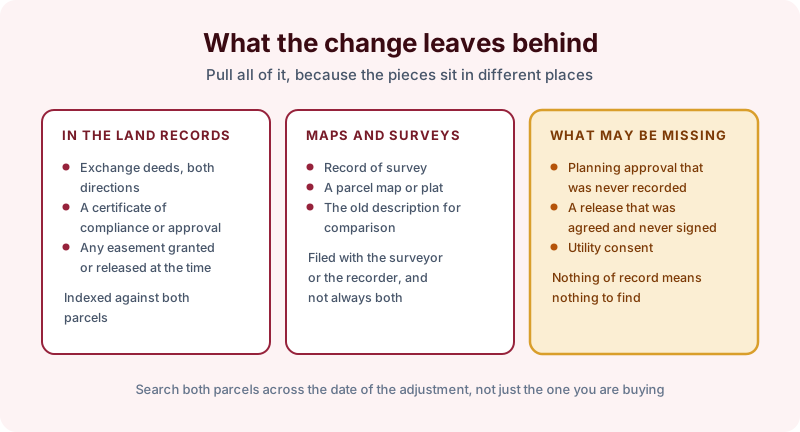
Pull all of it. The exchange deeds run in both directions, and reading only one of them gives you half the transaction. A certificate of compliance, a lot line adjustment approval or a similar municipal document is often recorded alongside them, and so is any easement granted or released at the same time, which is the moment a careful adjustment handles the problem.
Maps are the other half. A record of survey or a parcel map frequently carries the clearest picture of what moved, and these are not always filed in the same place as the deeds. Where the two parcels came out of a platted subdivision, the plat itself may carry easements that predate everything else, a pattern covered in easements created by a subdivision plat.
What may be missing is the planning approval itself, where local practice is to keep it in a file rather than record it against the land. Nothing recorded means nothing for a search to find, which is the ordinary limit.
Mortgages are worth a separate look. A lender’s deed of trust carries the description that existed when it was signed, and an adjustment does not amend it. That can leave a mortgage encumbering ground the borrower no longer owns, or leaving out ground they just acquired, until somebody records a modification or a partial release. It is the same mismatch, read from the lender’s side, that when the burdened land is divided describes from the easement’s.
The takeaway
Search both parcels, and search across the date of the adjustment rather than from it. An easement recorded against the parcel as it was described in 1994 is still good against the land, and the current description is not a reliable handle on it. A search reports what has been recorded and indexed in that county over the term searched, and practice varies from one recorder to the next. Whether a particular easement survived, merged or moved is a legal conclusion for counsel. Start the order online, or send us the address and the county and we will tell you which term fits and what a search of that scope would and would not cover before anything is ordered.