

· AFX Research
When the Benefited Land Sits in a Different County Entirely
Why an easement grant is recorded where the burdened land sits, what that does to a search of the parcel that benefits, and how to scope the work from both ends.
Table of Contents
Recording follows the burden. An easement deed goes to the office where the servient parcel sits, gets indexed against the owner who gave the right, and describes the strip being burdened. None of that happens in the county where the benefited parcel lies, and on a rural tract whose only access runs across the line into the next county, the practical consequence is blunt. A search of the land you are buying can come back showing no easement at all, while the access it depends on is sitting perfectly well recorded forty miles away.
Where the grant goes
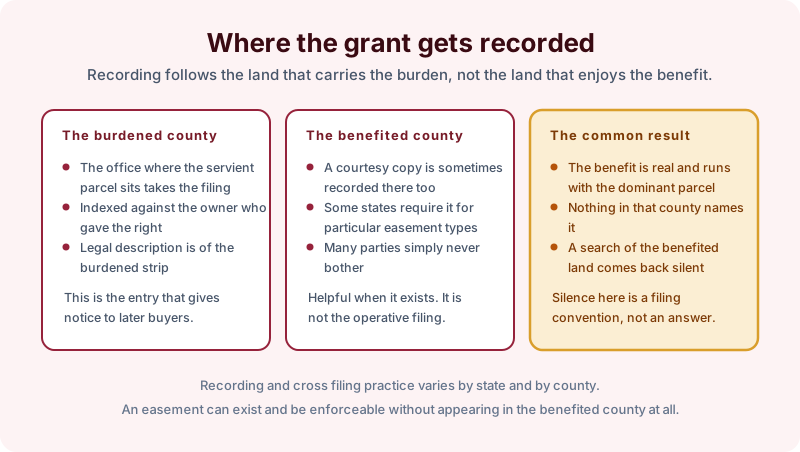
The filing in the burdened county is the operative one, because that is the entry that gives notice to anyone later buying the servient land. A courtesy copy in the benefited county is sometimes recorded as well, and a few states require cross-filing for particular easement types, but in most transactions nobody bothers.
So the ordinary outcome is an appurtenant right that genuinely runs with the dominant parcel and is named nowhere in that parcel’s own county. The silence is a filing convention, not a finding, and a report that presented it as a finding would be misleading. It is the same distinction that separates an appurtenant right from a personal one in easement appurtenant versus easement in gross.
Searching from the benefited side
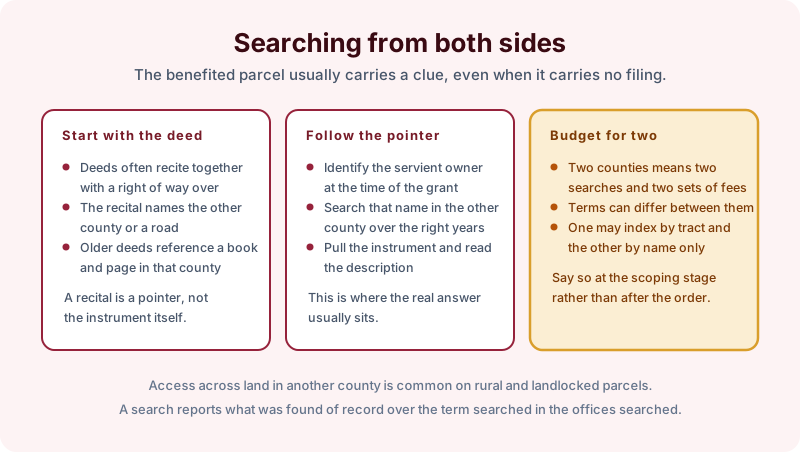
The benefited parcel usually carries a clue even when it carries no filing. Deeds in its chain commonly recite together with a right of way over, and that recital names a road, a neighbor or a book and page in another county. Older deeds are often explicit about it.
A recital is a pointer, not the instrument. The useful next step is to identify who owned the servient land at the time of the grant, search that name in the other county over the right years, pull the instrument and read the description. That is where the real answer sits, and it is why an access question on a landlocked tract so often turns into two searches rather than one. Our note on landlocked property and easements by necessity covers what happens when no grant turns up anywhere.
Budget for both. Two counties means two sets of fees, the terms may need to differ, and one office may index by tract while the other indexes by name only — which changes what a shorter term can realistically catch. That belongs in the scoping conversation, not in a surprise after the order.
What the second county holds
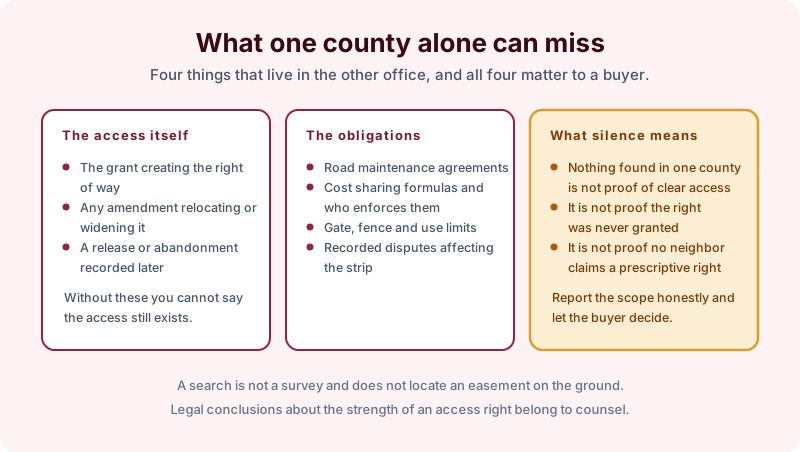
Four things live over there and all four matter. The grant creating the right of way, any amendment relocating or widening it, any release or abandonment recorded later, and the obligations that come with it — maintenance agreements, cost-sharing formulas, gate and use limits, and any recorded dispute affecting the strip. Our note on private road maintenance agreements is about documents that usually sit in exactly this position.
Without the second search you cannot say the access still exists, and you certainly cannot say it is unencumbered.
One more wrinkle is worth naming. Where a county line has itself moved, or where a parcel straddles it, the same instrument can have been recorded in a jurisdiction that no longer holds the land. Boundary changes between counties are rare but not extinct, and an old grant filed under the arrangement that existed at the time stays exactly where it was filed. Identifying which office held the land on the date of the grant, rather than which office holds it now, is part of scoping the search properly on an older chain.
The takeaway
Recording and cross-filing practice varies by state and by county, so nothing here holds everywhere, and a quiet report from one office is not proof that access is clear or that no neighbor holds a prescriptive claim. A search is also not a survey and does not locate the strip on the ground. What it can do is read both sides of the line and hand you the instruments found. Turnaround is 2–3 business days. Start the order online, or send us the address and the county and we will tell you which term fits and what it would and would not cover before anything is ordered.