

· AFX Research
Paper Streets and Platted Rights of Way That Were Never Built
A street drawn on an old subdivision plat and never constructed can still carry access rights, still appear in a title commitment, and still have a shed standing in it.
Table of Contents
Pull the plat for an older subdivision and you will often find streets that do not exist. They were drawn, named and dedicated when the subdivision was laid out, and then nobody ever built them. The strip is woods, or lawn, or somebody’s driveway. A paper street is one of the more common surprises in a title commitment, and it is worth understanding before it turns into a dispute with a neighbor.
How one is created
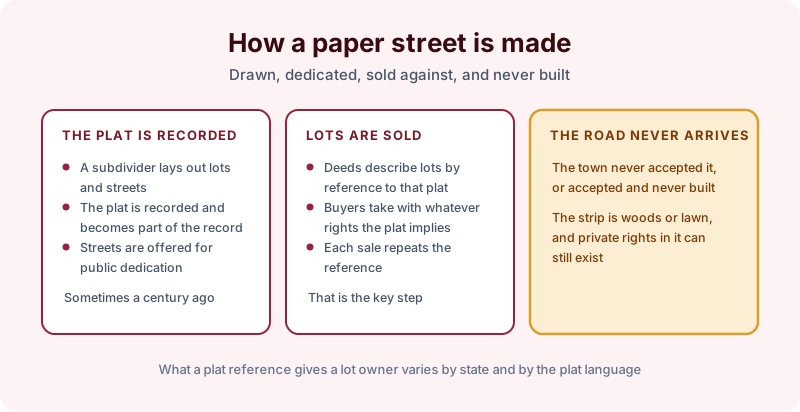
A subdivider records a plat showing lots and the streets that will serve them, offering those streets for public dedication. Lots are then sold by deeds that describe them by reference to that plat.
That reference is the part that matters. In many states a purchaser who buys a lot described by a recorded plat acquires private rights in the streets shown on it, whether or not the municipality ever accepted them, and whether or not anybody ever graded a road. Those rights run to the other lot owners rather than to the public, and they can survive for a very long time. The general mechanism for plat-created burdens is covered in easements created by a subdivision plat.
What a lot owner actually gets varies by state and by the language on the plat, which is why this is a question for counsel rather than one an abstractor answers.
Accepted, vacated, or neither
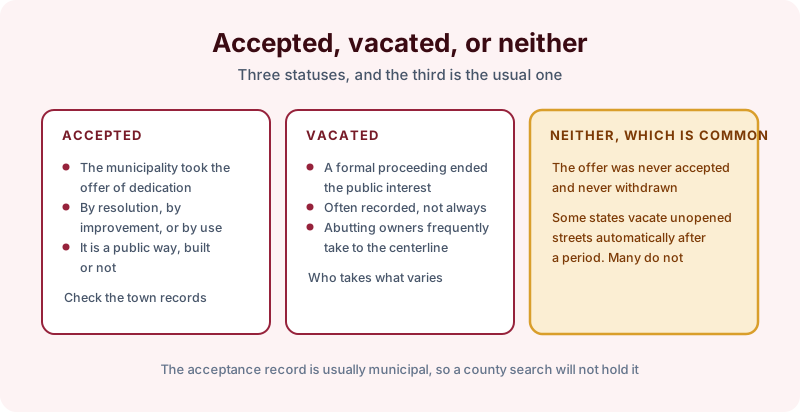
An offer of dedication has three possible fates and the third is the usual one.
It may have been accepted, by formal resolution, by improving the street, or in some states by public use over time. It is then a public way whether or not it was ever paved, and the acceptance record normally sits with the municipality rather than the county recorder, which is why a land records search alone will not settle it.
It may have been vacated through a formal proceeding that ended the public interest. Vacations are often recorded and not always, and who takes the vacated strip varies, though abutting owners taking to the centerline is a common outcome. Our note on vacated streets and alleys covers that case directly.
Or neither happened, which is the ordinary situation. The offer was never accepted and never withdrawn, and the strip sits in limbo. Some states have statutes that automatically vacate unopened streets after a stated period. Many do not.
Why it still matters
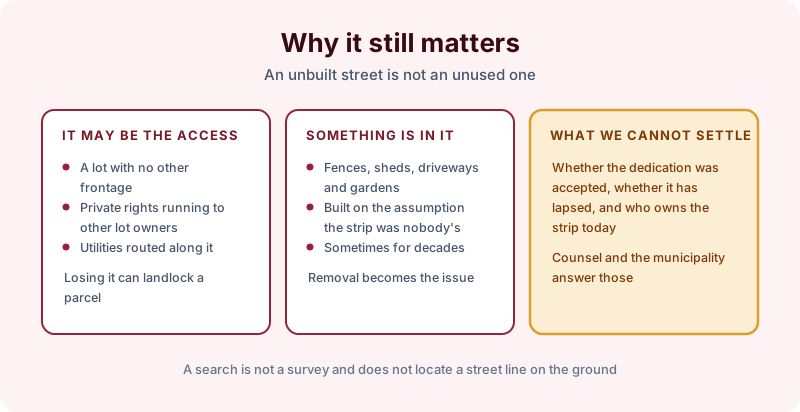
Two situations make this expensive rather than academic.
The first is access. A lot whose only frontage is on a paper street depends on that strip, and so may the utilities routed along it. Extinguishing it can landlock a parcel, which is the problem described in landlocked property and easements by necessity.
The second is that something is usually built in it. Fences, sheds, garages, driveways and mature gardens get placed in a strip everybody assumed belonged to nobody, sometimes for decades, and the question then is whether they have to come out. That is the same collision covered in encroachment or easement.
What to ask for
Order the plat itself, not just the deeds, and read it for the street names, the widths and any dedication language. Then ask the municipality whether the street was ever accepted or vacated, since that record is theirs.
Reaching the original plat is a term question, and the longer searches in our easement search packages exist for exactly this kind of work.
The takeaway
An easement search reports what was recorded and found in the indexes reviewed over the term searched, in the county where the property sits. It cannot tell you whether a dedication was accepted, whether it has lapsed under state law, or who owns the strip today, and it is not a survey, so it does not locate a street line on the ground. Start the order online, or send us the address and the county and we will tell you which search term fits and what it would and would not cover before anything is ordered.